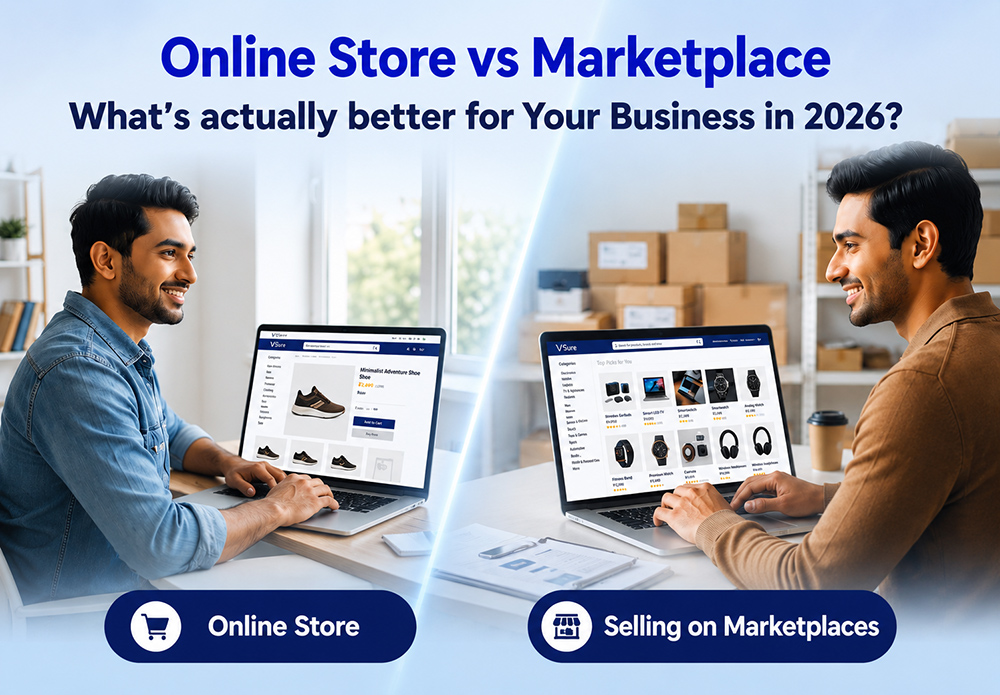

Picking where to sell is one of the most important decisions a business owner makes online. The platform you choose decides who owns your customer data, how much of every sale ends up in your account, how fast you can scale, and whether you are building a brand or just a temporary listing on someone else's website.
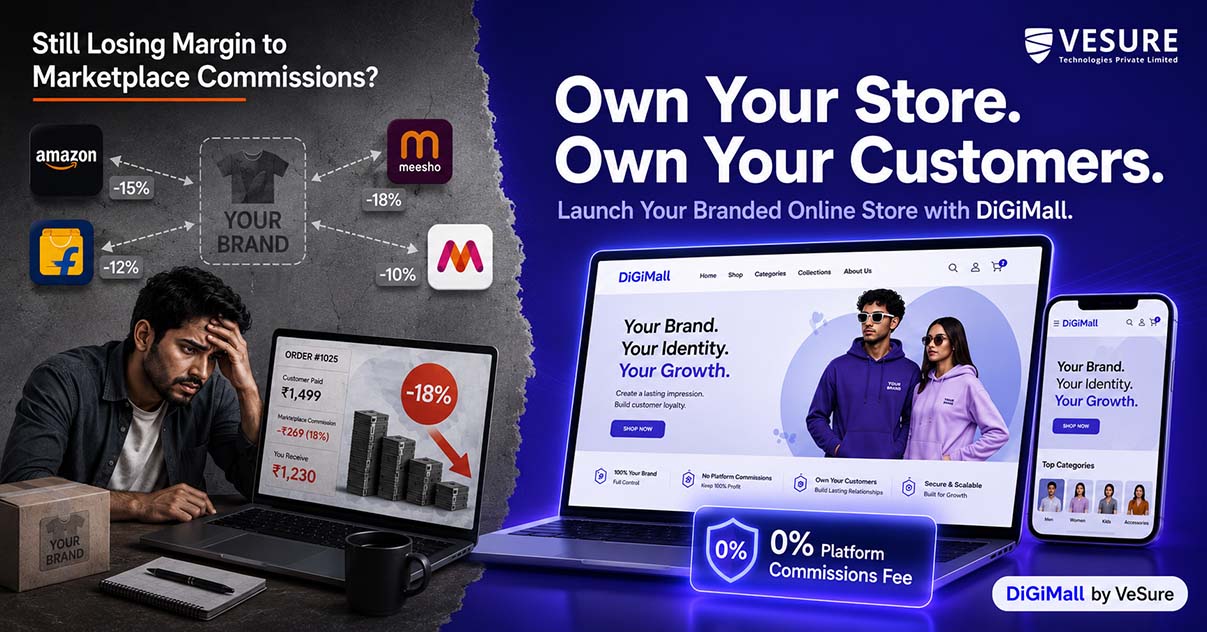
Most Indian sellers start on Amazon, Flipkart, or Meesho because it feels easy, and it is. The challenge shows up later, when commissions eat your margin, you cannot run remarketing campaigns to your own buyers, and changing the marketplace's algorithm changes your monthly revenue overnight. This guide walks through the three main options, what to actually evaluate, and how to make a choice that protects your business long term.
Table of Contents
- What is an Online Selling Platform?
- The Three Main Types of Selling Platforms
- Marketplace vs Own Online Store: Side-by-Side Comparison
- 8 Factors to Evaluate Before Choosing a Selling Platform
- VeSure DiGiMall- Built for Indian Sellers and Multi-Vendor Marketplaces
- Real Use Cases Across Industries
- Common Mistakes to Avoid
- Frequently Asked Questions
What is an Online Selling Platform?
An online selling platform is software that lets your business sell products or services to customers over the internet. It handles product listings, payments, orders, inventory, and customer communication- all the moving parts of running an online store or marketplace.
Selling platforms fall into three broad categories: marketplaces where you list as a seller alongside others, your own branded online store on your domain, and multi-vendor platforms where you run a marketplace of your own and let other sellers list on it. Each fits a different kind of business, and the right choice depends on your goals, not on what is cheapest or fastest to set up.
The Three Main Types of Selling Platforms
1. Marketplaces (Amazon, Flipkart, Meesho, Myntra)
You list your products on a marketplace that already has millions of buyers. The platform handles traffic, payments, and often logistics. You handle inventory and fulfillment.
Best for: businesses testing new products, sellers focused on quick volume, or anyone who wants minimal setup. Trade-off: high commissions (commonly 10–35%), no control over branding, no customer data, and platform policies that can change at any time.
2. Your Own Online Store
You build a branded e-commerce store on your own domain- example.com, using an e-commerce platform like DiGiMall, Shopify, or WooCommerce. You own the storefront, the customer relationships, the pricing, and the data.
Best for: businesses building a brand, businesses with repeat-purchase products, D2C sellers, and anyone planning to scale. Trade-off: you bring the traffic through SEO, ads, social media, and word of mouth.
3. Multi-Vendor Marketplace (Your Own Platform)
You build a marketplace where multiple sellers list and sell. You earn through commissions, listing fees, or subscriptions instead of selling products yourself. Examples in India include niche marketplaces in fashion, handicrafts, B2B, and local commerce.
Best for: businesses with category expertise, community-driven sellers, or aggregators serving a specific region or industry. Trade-off: requires investment in seller Onboarding, dispute management, and category curation.
Marketplace vs Own Online Store: Side-by-Side Comparison
Here is the quick decision view.
| Factor | Online Marketplaces (Amazon, Flipkart, Meesho) | Own eCommerce Website |
| Setup Time | 1–3 days to create listings and start selling | 2–4 weeks to launch a professional online store |
| Customer Reach | Access to millions of active shoppers with existing demand | Requires traffic generation through digital marketing |
| Brand Visibility | Limited branding opportunities under marketplace guidelines | Complete control over branding, design, and customer experience |
| Profit Margin | Lower margins due to commissions and marketplace fees | Higher margins with only payment gateway and marketing costs |
| Customer Data Ownership | Customer information is controlled by the marketplace | Full access to customer data and purchase insights |
| Pricing Flexibility | Restricted by marketplace pricing policies | Complete freedom to set pricing and offers |
| Marketing Options | Primarily limited to marketplace advertising tools | SEO, Google Ads, Meta Ads, WhatsApp Marketing, and Email Campaigns |
| Long-Term Business Growth | Helps grow the marketplace's ecosystem | Builds a valuable digital asset for your brand |
| Best Use Cases | Fast sales, product validation, and inventory clearance | Brand building, customer retention, and business scalability |
8 Factors to Evaluate Before Choosing a Selling Platform
1. Your Long-Term Business Goal
If you are testing a product or generating short-term cash, a marketplace works fine. If you are building a brand that customers come back to, your own store wins. Start with the goal, not the platform.
2. Profit Margin and Total Cost
Marketplaces feel cheap until you add up commissions, payment gateway charges, return logistics, and advertising fees. A 25% commission on every order means a Rs. 1,000 product earns you Rs. 750 before COGS. Your own store has a higher setup cost but lower per-order cost. Calculate the total, not just the entry cost.
3. Customer Data Ownership
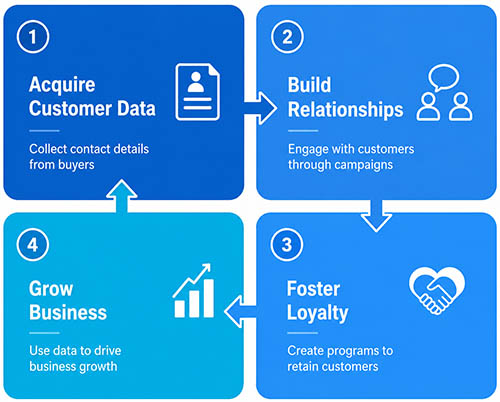
On a marketplace, you do not own the customer. You cannot email them, run WhatsApp campaigns to them, or build a loyalty program. In your own store, every buyer's contact details belong to your business, which compounds as a growth asset over time.
4. Design and Customization
Your store is your digital storefront. The platform should give you control over branding, product layouts, mobile experience, and checkout flow. Look for mobile-first design, fast loading speed, easy product management, and SEO-friendly URLs out of the box.
5. SEO and Marketing Capability
Marketplaces give you almost zero SEO control. Your own store lets you target keywords, build category content, run Google and Meta ads to specific products, and grow organic traffic that compounds for years. Modern e-commerce platforms should support meta tags, schema markup, blog publishing, and integration with Google Analytics.
6. Payments and Security
In India, your platform must support UPI, cards, net banking, wallets, and cash on delivery. Look for SSL security, encrypted payment gateways, and a clean checkout flow. Trust matters most to Indian buyers, who abandon checkout if the page feels even slightly off.
7. Scalability
The right platform should handle your business at 50 orders a day and 5,000 orders a day. Ask the vendor about traffic limits, server capacity during sale events, multi-warehouse inventory, and how the platform behaves under load. Picking a tool that breaks at scale forces a painful migration later.
8. Support and Ease of Use
You should be able to add products, update prices, manage orders, and run promotions without needing a developer. Equally important, the platform vendor should offer support in your time zone and language. A US-based platform with chat support that opens at 9 PM IST will not help when your store goes down on a Monday morning.
VeSure DiGiMall — Built for Indian Sellers and Multi-Vendor Marketplaces
Most e-commerce platforms in the market are built around the United States or European e-commerce experience large average order values, low cash-on-delivery share, and customers are comfortable with a single payment method. Indian commerce works differently. COD still matters, UPI dominates online payments, and buyer behavior varies sharply between metros and Tier-2/Tier-3 cities.
VeSure DiGiMall is built around how Indian businesses actually sell. Whether you are launching a single-brand D2C store, a multi-category online store, or a full multi-vendor marketplace, DiGiMall supports the workflow without forcing you to bolt on plugins for every feature.
What VeSure DiGiMall gives your business:
- Product management and catalogue- categories, variants, bulk uploads, and rich product pages from a single dashboard.
- Multi-vendor marketplace supports onboarding sellers, manages commissions, and runs a full marketplace under your brand.
- Payment gateway integration with UPI, cards, net banking, wallets, and cash on delivery.
- Order tracking and management with status updates, returns handling, and customer notifications.
- Store customization- branded themes, mobile-first design, and SEO-ready product pages.
- Inventory sync across products and (if needed) across multiple warehouses or sales channels.
VeSure Technologies is CMMI Level 3 and ISO 27001 certified, which means your customer data and payment information are handled with internationally recognized security standards- important when you are processing thousands of orders and storing customer details at scale.
Real Use Cases- How Indian Businesses Use DiGiMall
D2C Skincare Brand in Bengaluru
A founder selling small-batch skincare started on Amazon and Flipkart. After a year, marketplace commissions plus return logistics were eating roughly 35% of revenue. Migrating to a branded DiGiMall store let her build a customer email list, run targeted WhatsApp campaigns to past buyers, and grow repeat purchases. Marketplace remained a secondary channel, but the brand-owned store became the primary revenue source within 8 months.
Multi-Vendor Marketplace for Handicrafts in Jaipur
A businessman in Jaipur wanted to bring 150+ local artisans online under one branded marketplace. A regular store platform could not handle multiple sellers with separate dashboards, payouts, and commission tracking. DiGiMall's multi-vendor setup lets him onboard sellers, manage commissions automatically, and present the marketplace under his own brand- without building anything from scratch.
Manufacturing Company in Delhi NCR Going B2B Online
A B2B manufacturer wanted to give wholesale buyers a self-service portal- see catalogues, place bulk orders, track shipments. Instead of building a custom solution, they used DiGiMall's e-commerce engine with a B2B-style configuration. Order volumes went up because customers could place repeat orders themselves, and the sales team was freed up to focus on new accounts.
Common Mistakes Businesses Make While Choosing a Selling Platform
- Going marketplace-only because it is faster. Speed is real, but you end up building someone else's business instead of your own.
- Choosing the cheapest platform without checking limits. Free or low-cost platforms often cap product counts, traffic, or features behind paid tiers.
- Ignoring mobile experience. Over 75% of Indian e-commerce traffic is mobile. If your store does not load fast on a 4G connection, you have already lost the sale.
- Not planning for COD. Many international platforms make COD an afterthought. In India, it still drives a major share of orders- especially in Tier-2 and Tier-3 cities.
- Skipping SEO from day one. If your platform does not let you control meta tags, URLs, and schema markup, organic traffic- your cheapest growth channel- never takes off.
Final Thoughts
There is no universal best answer here. Marketplaces work for short-term volume. Your own store works for long-term brand and margin. A multi-vendor platform works if you are building a category or community-led marketplace.
What matters most is matching the platform to your business goal. If you want to keep customer data, control pricing, run marketing, and build something that compounds over five years, your own store is the right answer. If you just want orders this quarter and are not yet sure the product will work, start on a marketplace, but plan the transition early.
If you are planning to launch a branded online store or a multi-vendor marketplace, explore VeSure DiGiMall or book a free demo to see how the platform fits your business model.
Frequently Asked Questions
What is the best-selling platform for a small business in India?
The best-selling platform for a small business in India depends on the goal. For quick sales and product testing, marketplaces like Amazon, Flipkart, and Meesho work. For long-term brand building, repeat customers, and higher profit margins, a branded online store on a platform like VeSure DiGiMall is the better choice. Many growing businesses use both- marketplaces for reach, own store for brand.
Is selling on Amazon or Flipkart better than having your own website?
Marketplaces give you an instant audience but take 10–35% in commissions, do not give you customer data, and limit your branding. Your own website costs more upfront but gives you full control over pricing, customer relationships, and marketing. For most serious sellers, the right answer is to use marketplaces as a discovery channel and an own-branded store as the long-term business.
How much does it cost to start an online store in India?
Starting an online store in India is far more affordable than it used to be. Platforms like VeSure DiGiMall offer plans that fit small to mid-sized businesses without a large upfront investment. Total cost depends on product range, design needs, payment gateway charges (typically 2% per transaction), and marketing budget, not on heavy software licensing.
Can I sell on a marketplace and run my own online store at the same time?
Yes, and most growing businesses do exactly this. Use marketplaces as a discovery channel where new customers find your brand, and your own store as the place where loyal customers buy directly, get better offers, and join your loyalty program. This hybrid approach gives you marketplace reach plus brand ownership.
What is a multi-vendor marketplace platform?
A multi-vendor marketplace is a platform where multiple sellers list and sell products under one branded storefront, like Amazon, but on a smaller, niche scale. The marketplace owner earns through commissions, listing fees, or subscriptions. VeSure DiGiMall supports multi-vendor setups out of the box, which is useful if you are building a category-specific or community-driven marketplace.
How important is mobile experience for an online store in India?
Extremely important. Over 75% of Indian e-commerce traffic comes from mobile devices, and that share keeps growing in Tier-2 and Tier-3 cities. A store that is not mobile-first, fast loading, clean checkout, and UPI support loses most of its potential buyers before they ever reach the product page.