Every HR trends report published this year mentions "agentic AI." Almost none of them explain what an HR manager running payroll for 80 people on a Friday evening is actually supposed to do with that information. This blog is written for that person.
If you've read any HR technology report this past year, you've seen the term agentic AI. Most of that research points to fast growth in AI agent adoption across HR — but it's framed around large enterprises with their own HR-tech teams. So for a 50-person manufacturing unit in Faridabad, or your uncle's 150-person retail chain, it can feel like someone else's conversation.
It doesn't have to. Putting all the jargon aside, agentic AI in HR really means only one thing: software that acts, instead of tracking your data. This post shows what agentic AI actually looks like at the SME scale — and where you can start today.
QUICK ANSWER
Agentic AI in HR refers to software that acts on HR data, including flagging instances of attendance anomalies or auto-assigning leave approvals or predicting turnover risk based on this data, rather than merely storing and exhibiting it. This does not imply getting rid of HR staff and replacing them with bots for Indian SMEs. We are talking about a system to deal with repetitive decisions without human interference that allows your HR team to spend time on people, not paperwork.
What "Agentic AI" Actually Means (Without the Buzzword)
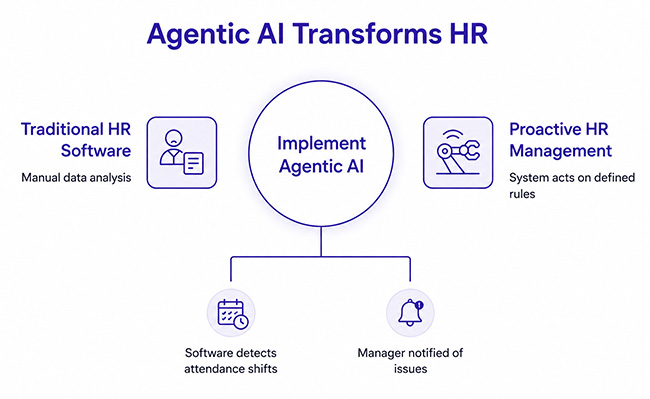
Traditional HR software is a record-keeper. You enter data, it stores the data, and a person looks at reports to decide what to do next. Agentic AI changes the last step: the system itself takes the next action, within rules you define.
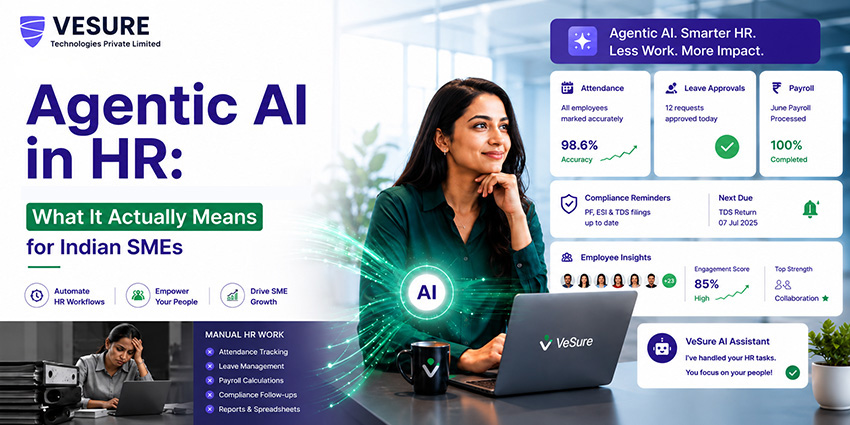
A practical example: in a traditional HRMS, if an employee's attendance pattern shifts - say, three late arrivals in a week after months of punctuality - that pattern sits in a report someone has to notice. In an agentic system, the software flags it automatically and can even notify the relevant manager before it becomes a performance conversation that starts too late.
That's the entire shift. Not robots making HR decisions for you - software noticing things and acting on simple, defined rules, faster than a person checking reports once a month would.
Where This Actually Shows Up for SMEs (Not Just Enterprises)
1. Attendance and Payroll Anomaly Detection
Instead of HR manually scanning attendance logs before payroll, the system flags inconsistencies - missed punches, unusual overtime spikes, repeated late marks - as they happen. This connects directly to attendance accuracy; see our breakdown on why manual attendance tracking quietly costs businesses money for the underlying problem this solves.
2. Smart Leave and Approval Routing
Leave requests that meet policy criteria can be auto-approved, while only exceptions reach a manager's desk. For a business processing dozens of leave requests a week, this alone removes a meaningful chunk of repetitive approval work.
3. Recruitment Screening at SME Speed
Most SMEs don't have a dedicated recruiter sifting through 200 resumes for one role. Basic AI-assisted screening - matching resumes against role requirements - narrows that pile to a shortlist a manager can actually review properly, instead of skimming.
4. Early Turnover Signals
Patterns like declining attendance, fewer system logins, or a steady drop in day-to-day engagement are often the earliest signs an employee is planning to leave. Getting out ahead of this stuff allows for a dialogue before the resignation letter, not after.
5. Compliance Reminders That Don't Rely on Memory
Certifications, expiries, statutory filings deadlines, and policy renewal dates are tracked and flagged automatically rather than being left up to someone’s calendar reminder.
What Agentic AI in HR Is Not
It's worth being direct about the limits, because overpromising here does businesses a disservice. Agentic AI is not a replacement for HR judgment on sensitive matters - performance reviews, disciplinary action, and termination decisions still need a human who understands the context that the system doesn't have. Industry guidance is consistent on this point: AI works best as an assistant that handles repetitive, rule-based decisions, not as the decision-maker on anything involving nuance, fairness, or legal risk.
It's also not free of setup work. The value only shows up once your attendance, leave, and payroll data is clean and centralized - which is exactly why this only makes sense after fixing the basics, not before.
How VeSure HRMS Approaches This
VeSure HRMS is built around the principle that automation should solve a real bottleneck, not add a layer of complexity SMEs don't need. The platform's attendance and leave management, payroll processing, and performance tracking modules are designed to flag anomalies and route repetitive approvals automatically, so HR managers spend their time on the decisions that actually need a person - not the ones that don't.
This is intentionally scoped to where automation creates real value for a 10-to-1,000-employee business: attendance accuracy, payroll consistency, and leave processing - not abstract enterprise-scale workforce modeling that most SMEs will never need.
A Practical Starting Point
If your business is wondering where to start with AI-assisted HR, the honest answer is: start with the data you already have a problem with.
- Fix attendance and leave tracking first - automation amplifies clean data and amplifies messy data equally.
- Identify the one repetitive HR task your team complains about most. That's usually the highest-value place to automate first.
- Choose a system that flags anomalies for human review, rather than one that claims to make decisions autonomously - for SMEs, oversight matters more than full automation.
- Measure HR hours saved over the first quarter, not just whether the software "has AI features."
Conclusion
Agentic AI in HR isn't a future enterprise trend that SMEs need to wait for - it's already showing up in attendance flags, leave routing, and turnover signals inside everyday HRMS platforms. It's not the companies chasing the bleeding-edge AI feature set that are getting real value from it. They seemed to be the ones who automated the most monotonous, error-resistant role within HR first, and then let the system come in on all of the activities that it truly excels at, such as identifying trends quicker than a person passively looking at an Excel sheet once every month.
Frequently Asked Questions
Is agentic AI in HR only relevant for large enterprises?
No. The core capability - flagging anomalies and automating repetitive decisions - is just as valuable, often more so, for a 50-200 employee business where HR is a small team handling everything manually.
Will AI in HRMS replace HR staff?
No. It removes repetitive, rule-based work - like scanning attendance logs or routing standard leave approvals - so HR staff can focus on hiring, employee relations, and decisions that genuinely need human judgment.
What's the difference between a regular HRMS and one with agentic AI features?
A regular HRMS stores and displays data for a person to act on. An HRMS with agentic capabilities flags issues and routes simple decisions automatically, within rules you set, reducing the manual review step.
Do we need clean historical data before using AI features in our HRMS?
Yes, ideally. Anomaly detection and pattern flagging work best when attendance and leave data are already accurate and centralized - which is why fixing basic data hygiene comes before layering on automation.
How do we know if our business is ready for this?
If your HR team is currently spending significant time on manual attendance checks, leave approvals, or compliance reminders, that's the signal you're ready - those are exactly the tasks agentic features are built to handle.
Curious where automation could actually save your HR team time? Explore VeSure HRMS or book a walkthrough to see which of your current manual tasks could be automated first.