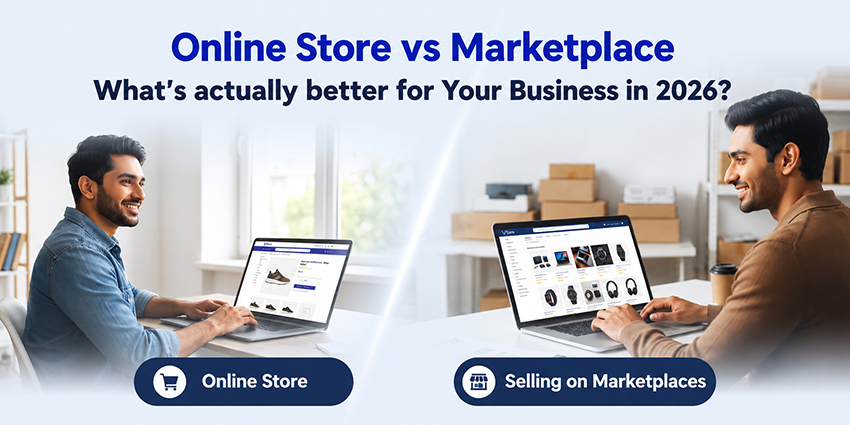
Online Store vs Marketplace: What's actually better for Your Business in 2026?
You have built a product people want to buy. Now comes the harder decision: do you list it on Amazon and Flipkart where the customers already are, or do you put your money and time into your own online store where nobody's shopping yet?
Most sellers answer this with a gut feeling. That's expensive. The right answer depends on your margins, your growth stage, and whether you're building a brand or just moving inventory and in 2026, with India's e-commerce market pushing past $150 billion and marketplace fee structures getting more complex every quarter, guessing wrong costs more than it used to.
QUICK ANSWER
Selling on marketplaces like Amazon, Flipkart, or Meesho gets you in front of buyers immediately, but you'll give up 5–25% in commissions per sale, hand over your customer data to the platform, and compete shelf-to-shelf with everyone else in your category. Your own online store costs more to set up and takes longer to attract traffic, but you keep 100% of the customer relationship, control your margins, and own an asset that compounds in value. Most growing Indian businesses in 2026 aren't choosing one — they're using marketplaces to generate cash flow and reviews early on, then building a branded store as the primary long-term channel once demand is proven.
The rest of this guide breaks down exactly where each model wins, what it actually costs, and how to decide which one fits your business right now.
Table of Contents
- What's the Real Difference Between an Online Store and a Marketplace?
- Selling on Marketplaces: What You Gain and What It Costs You
- Building Your Own Online Store: What You Gain and What It Costs You
- Online Store vs Marketplace: Side-by-Side Comparison
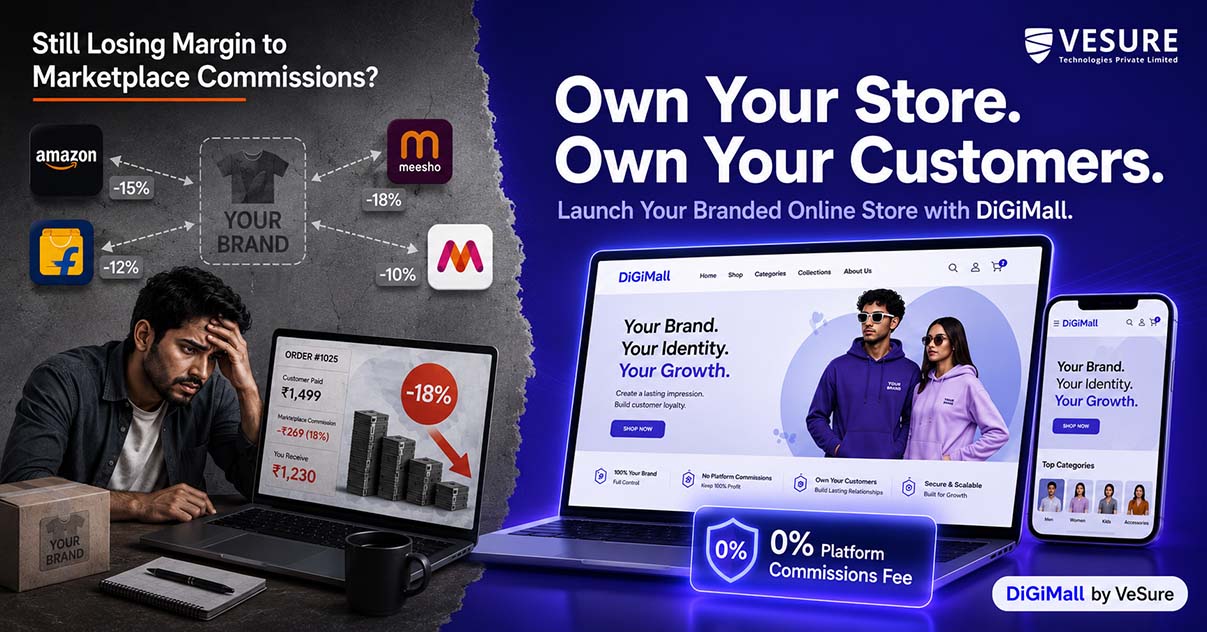
- Where This Money Actually Goes: A ₹999 Product, Two Ways
- How VeSure's DiGiMall Removes the Biggest Barrier to Owning Your Store
- Real Businesses, Real Choices: How Indian Brands Have Used Both
- A Simple Framework to Decide: 3 Questions Before You Choose
- Getting Started: What to Look For, Whichever Path You Pick
- Frequently Asked Questions
What's the Real Difference Between an Online Store and a Marketplace?
An online store is a website you own your domain, your design, your checkout, your customer list. Think of it as your own shop on a street you built. A marketplace (Amazon, Flipkart, Meesho, Myntra) is rented shelf space inside someone else's mall. You get their foot traffic, but you follow their rules, pay their rent, and your shopfront looks like every other seller's.
Neither model is "better" in the abstract. The question is what stage your business is at, and what you're optimizing for: speed to first sale, or long-term brand equity.
Selling on Marketplaces: What You Gain and What It Costs You
The upside
Marketplaces solve the hardest problem in e-commerce getting in front of buyers who are already searching to buy. India's top platforms now handle a combined Gross Merchandise Value (GMV) in the tens of billions of dollars, and the Open Network for Digital Commerce (ONDC), the government-backed open e-commerce protocol, crossed 10 million transactions per month in 2026, giving smaller sellers another route into that same buyer traffic without needing their own storefront.
- Instant discoverability. Your product shows up in search results and category browsing from day one.
- Trust transfer. Buyers who don't know your brand will still buy because they trust Amazon's or Flipkart's return policy.
- Zero infrastructure. No hosting, no payment gateway integration, no checkout to build.
- Built-in logistics. Fulfilment, delivery, and returns are largely handled for you (for a fee).
The real cost
This is the part most sellers underestimate until they see their first payout statement. Marketplace fees in 2026 are not a flat "commission" — they're a stack:
- Amazon India: referral/commission fees ranging roughly 5% to 25% depending on category, plus closing fees, weight-based shipping, and optional FBA storage charges.
- Flipkart: commission generally runs from about 3% for mobiles up to 25% for categories like fashion jewelry, plus a fixed per-order fee and shipping — and Flipkart also applies 18% GST on top of the commission amount itself.
- Meesho: markets itself as zero-commission, and technically it is — but sellers still pay a platform fee per order plus weight-and-zone-based logistics charges, and once you factor in advertising to stay visible, the real cost of selling on Meesho in 2026 typically works out to roughly 10–15% of the product price, not zero.
On top of the fee stack: you don't own the customer. You can't email them next month about a new launch, retarget them on Meta, or build a loyalty program, the platform owns that relationship, not you.
Building Your Own Online Store: What You Gain and What It Costs You
The upside
- Full brand control. Every page, every product photo, every checkout step reflects your brand not a template shared with 10,000 other sellers.
- You own the customer data. Every visit, cart abandonment, and repeat purchase is yours to analyze and act on.
- Better unit economics at scale. No per-order commission cut. Your main recurring cost is platform/hosting and payment gateway fees, far lower than a 15–25% marketplace commission once you have consistent order volume.
- You can build for the long term. SEO rankings, email lists, and repeat customer’s compound. A marketplace listing doesn't carry over if you switch platforms; your own domain's authority does.
The real cost
- You are responsible for driving your own traffic through SEO, social media, paid ads, or WhatsApp marketing. There's no built-in footfall.
- Initial setup takes real time: product pages, payment gateway integration, GST-compliant invoicing, and a mobile-optimized checkout all need to be right before launch.
- Trust has to be earned. New visitors don't automatically know your return policy or delivery reliability the way they trust an established marketplace.
Online Store vs Marketplace: Side-by-Side Comparison
|
Factor |
Your Own Online Store |
Marketplace (Amazon/Flipkart/Meesho) |
|
Brand control |
Full — your design, your rules |
Minimal shared template |
|
Customer data ownership |
Complete |
Platform retains it |
|
Per-sale cost |
Payment gateway fee only (~2%) |
5–25% commission + fixed fees + shipping |
|
Time to first sale |
Weeks (needs traffic building) |
Days (platform traffic exists) |
|
Repeat customer marketing |
Direct email, WhatsApp, retargeting |
Restricted or unavailable |
|
Long-term asset value |
Compounds (SEO, brand equity) |
Resets if you leave the platform |
|
Setup effort |
Medium to high, one time |
Low |
|
Best suited for |
Brand builders, D2C, repeat-purchase products |
New product testing, quick cash flow, low-differentiation goods |
Where This Money Actually Goes: A ₹999 Product, Two Ways
Numbers make this easier than percentages alone. Take a ₹999 product that costs you ₹400 to make and ship.
On a marketplace (using a mid-range Flipkart-style fee stack): after roughly 15–20% combined commission and fixed fees, plus GST on those fees, you typically settle around ₹750–₹800 before your product cost leaving a working margin in the ₹350–₹400 range, and less than that if the order is returned.
On your own store: after a ~2% payment gateway fee, you keep roughly ₹979 of the sale price, leaving close to ₹580 in margin on the same product before whatever you spend on marketing to acquire that customer.
The trade-off is visible right there: marketplaces convert existing traffic into a smaller margin per sale; your own store needs you to bring the traffic, but keeps a materially larger share of every rupee once you do.
How VeSure's DiGiMall Removes the Biggest Barrier to Owning Your Store
The reason so many Indian businesses default to marketplaces isn't that they prefer giving up 20% margin — it's that building and running a proper online store used to require a developer, a separate payment gateway integration, and ongoing technical maintenance most business owners don't have time for.
VeSure's DiGiMall is built specifically to close that gap for Indian businesses. It gives you:
- Product catalogue and inventory management synced in real time, so stock levels stay accurate across your storefront without manual updates
- Built-in payment gateway integration, so customers can pay by UPI, card, or net banking without you wiring up a separate provider
- Order tracking and management from a single dashboard, no juggling spreadsheets or three different seller panels
- Multi-vendor marketplace support, if you want to run your own branded marketplace rather than just a single-brand store
- Store customization that reflects your actual brand, not a shared theme
In practice, this means a business can launch a fully functioning, GST-billing-ready online store without hiring a developer or managing three separate tools for catalogue, payments, and orders, the exact overhead that pushes most first-time sellers toward marketplaces by default.
Real Businesses, Real Choices: How Indian Brands Have Used Both
Looking at how established Indian D2C brands actually built their businesses is more useful than theory:
- boAt built its early brand almost entirely around a direct-to-consumer website and app experience before scaling across marketplaces, the brand loyalty came first, marketplace distribution came second.
- Mamaearth (Honasa Consumer) grew as a D2C-first brand with tight control over its checkout and customer experience, later listing publicly a trajectory that depended on owning first-party customer data from day one.
- Lenskart is a useful 2026 case study: it went public on the NSE and BSE in November 2025, but its retail model has always combined its own app and website with physical stores rather than depending on third-party marketplaces for its core eyewear sales.
The pattern across all three: they used their own platform to build the relationship and the repeat-purchase habit, and used other channels, retail, and marketplaces, social as distribution on top of that foundation, not as a replacement for it.
A Simple Framework to Decide: 3 Questions Before You Choose
Skip the pros-and-cons list for a second and answer these three questions honestly:
- Do most of your customers buy from you more than once? If yes, owning the customer relationship (email, WhatsApp, retargeting) pays for itself fast, lean toward your own store. If it's mostly one-time purchases, marketplace traffic matters more than data ownership.
- Is your product differentiated, or is it a commodity? If buyers can find an identical product from ten other sellers, marketplace price competition will erode your margin regardless of platform. A distinct product justifies the investment in a branded store.
- Can you survive 60–90 days without meaningful organic traffic? Building an online store's SEO and audience takes time. If you need revenue in week one, start on a marketplace for cash flow, and build your own store in parallel rather than instead.
If two or more answers point toward "own the relationship," your online store should be the primary channel — with marketplaces as a secondary reach play, not the other way around.
Getting Started: What to Look For, Whichever Path You Pick
If you're building your own store:
- Choose a platform with built-in SEO structure, mobile responsiveness, and GST-compliant invoicing — not just a page builder
- Get product photography and descriptions right before launch; this is what marketplaces can't differentiate, and what your store lives on
- Set up WhatsApp or chat support early Indian buyers convert better with a responsive channel to ask questions before paying
If you're testing on a marketplace first:
- Start with one platform that matches your category (Meesho for budget/Tier 2-3 reach, Amazon for premium/branded positioning, Flipkart for mass-market fashion and electronics)
- Track your actual net margin per order, not just the sale price, the fee stack changes the math more than most new sellers expect
- Treat marketplace reviews and sales data as market research for what to feature on your own store later
Conclusion
There's no universal winner here, only what's right for where your business is today. Marketplaces are the fastest way to get your first hundred sales and validate demand. Your own online store is the asset that keeps paying you back in margin and customer loyalty for years after that. Most businesses that scale well in India by 2026 use both, but structure the mix deliberately: marketplace for reach, own store for retention and profit.
If the setup effort has been the thing holding you back from launching your own store, that's the specific problem VeSure's DiGiMall is built to solve.
Frequently Asked Questions
Is it better to sell on Amazon or build my own website in 2026?
It depends on your goal. If you need fast visibility and don't yet have a customer base, Amazon (or another marketplace) gets you sales sooner. If you're building a brand with repeat customers, your own website earns better margins over time because you're not paying 5–25% commission on every order and you retain the customer data to market to them again.
How much commission do Amazon, Flipkart, and Meesho charge sellers in India?
Amazon's commission generally ranges from about 5% to 25% depending on category, plus closing and shipping fees. Flipkart's commission runs roughly 3% to 25% by category, plus a fixed per-order fee and 18% GST charged on the commission itself. Meesho advertises zero commission, but once platform fees, logistics charges, and advertising are included, the effective cost typically works out to around 10–15% of the product price.
Can I sell on both a marketplace and my own online store at the same time?
Yes, and most growing Indian sellers do exactly this. A common approach is using marketplaces to reach new buyers and generate initial reviews and cash flow, while directing repeat customers and brand-loyal buyers to your own store, where margins are higher and you control the entire customer journey.
Do I need technical or coding skills to build my own online store?
Not anymore. Platforms like VeSure's DiGiMall are built so business owners can set up a product catalogue, connect payment gateways, and manage orders from one dashboard without hiring a developer or managing separate systems for inventory, payments, and order tracking.
What's the biggest mistake businesses make when choosing between the two models?
Treating it as an either/or decision instead of a sequencing decision. The businesses that build lasting brands— boAt and Mamaearth among them — used their own platform to own the customer relationship from early on, and layered marketplace or retail distribution on top of that, rather than building their entire business inside a rented marketplace listing they don't control.
Is GST registration required to sell online in India, regardless of the model?
Yes. Whether you sell through your own store or a marketplace, GST registration and GST-compliant invoicing are required for most business sellers in India, and marketplaces will ask for your GSTIN during seller onboarding. A platform with built-in GST-ready billing removes one more manual compliance task from your plate.
Ready to launch a store you actually own?
Explore VeSure's DiGiMall or book a demo to see how quickly you can go live with your own catalogue, payments, and order management — no developer required.