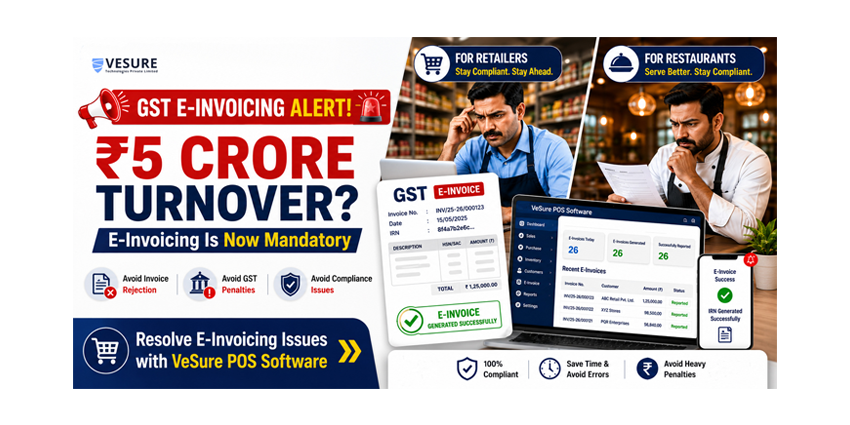
GST E-Invoicing Mandatory From ₹5 Crore Turnover: What Retailers and Restaurants Must Do Before Their Next Invoice
A restaurant owner in Karol Bagh "Delhi" found out the hard way. His accountant called on a Monday morning to say that some of last quarter’s invoices to a corporate catering client might not hold up if the GST department ever asks for proof. Nothing was wrong with the food or the billing amount. The problem was that the invoices never went through the government’s Invoice Registration Portal, because his POS software had no idea it needed to.
Well, a lot of retailers, restaurant owners, and pharmacy operators are going through this right now. GST e-invoicing mandate was up to ₹5 crore in aggregate turnover for businesses a month ago, but the rule makes more possessors than you would think catch. This article discusses who the rule really applies to, the cost of an unregistered invoice, and what you need to fix in your billing system before sending out your next bill.
Table of Contents
- What Is GST E-Invoicing, Exactly?
- Who Does the ₹5 Crore Rule Actually Cover?
- What Happens If You Skip an E-Invoice
- Why Retailers and Restaurants Are More Exposed Than They Think
- How VeSure POS Handles This Without Adding Work to Your Day
- A Real-World Scenario: A Three-Outlet Restaurant Group in Delhi NCR
- What to Do Before Your Next Invoice
- Conclusion
- Frequently Asked Questions
What Is GST E-Invoicing, Exactly?
In simple terms, GST e-invoicing is the process of getting a B2B tax invoice approved by the government before the invoice reaches your buyer. Your billing software simply generates the invoice as it always has. The only difference is that the invoice data is sent to the hiatus Registration Portal, checked, and gives a unique Invoice Reference Number back along with a digitally signed QR code. The invoice, without that IRN, dies since it does not satisfy the requirements of GST la,– and your buyer cannot use it to claim Input Tax Credit.
First, it is essential to clear up a common misconception: e-invoicing does not mean typing your invoice into a government portal. Just like before, you create the invoice in your own billing software. Then the software talks to IRP in the back end, fetches the IRN, and prints it onthe invoice sent to your customer. Your current system probably cannot do this automatically, so actually, every invoice you raise is technically incomplete.
Who Does the ₹5 Crore Rule Actually Cover?
The bit that probably shocks the most business owners out there is that this rule does not run off your turnover in the current year. If your GST aggregate turnover during any financial year since 2017-18 exceeded ₹5 crore, e-invoicing is applicable.
And if your restaurant chain did ₹5.4 crore in FY 2022-23 and has settled for ₹4 crore, you still qualify. The rule does not reset when your revenue drops.
There is a second layer that specifically affects multi-outlet businesses: the ₹5 crore threshold is calculated on a PAN basis, not per store or per GSTIN.
If you run four retail outlets or restaurant branches under one company PAN, their combined turnover is what counts, even if each outlet bills well under ₹1 crore. A lot of owners assume their single branch is too small to matter and miss this entirely.
Quick check: if your total billing across all branches under one PAN has ever touched ₹5 crore in a financial year since 2017-18, e-invoicing applies to your B2B and export invoices today, regardless of what your current-year turnover looks like.
Turnover Thresholds at a Glance
| Aggregate Annual Turnover (any year since FY 2017-18) | What Applies to You |
|---|---|
| Above ₹5 crore | E-invoicing mandatory for all applicable B2B invoices, exports, and credit/debit notes |
| Above ₹10 crore | E-invoicing is mandatory, plus invoices must be reported to the IRP within 30 days of the invoice date |
| Below ₹5 crore (never crossed it) | E-invoicing is not currently mandatory, though early adoption is recommended, given that the threshold has been lowered repeatedly since 2020 |
What Happens If You Skip an E-Invoice
An invoice issued without a valid IRN is treated as if no tax invoice was issued at all, even if the amount, GST rate, and every other detail are correct. That has two immediate consequences. Your buyer cannot claim Input Tax Credit on that invoice, which damages the relationship fast when the buyer is a distributor, corporate client, or catering partner who depends on that credit. And the penalty for non-issuance is steep: 100% of the tax due, or ₹10,000, whichever is higher, applied per incorrect invoice, not per filing period.
There is also a quieter cost that does not show up as a penalty notice. Document series rules reset every financial year, and GST authorities have been paying closer attention to mismatches between GSTR-1 filings and IRP records. A pattern of missing IRNs is the kind of thing that turns a routine filing into a longer conversation with the department.
Why Retailers and Restaurants Are More Exposed Than They Think
Most restaurant owners think of their business as B2C, walk-in customers paying their own bill, so e-invoicing feels like someone else’s problem. In practice, a restaurant with catering contracts, corporate meal accounts, or supply tie-ups with food aggregators is issuing genuine B2B invoices, and those fall squarely under the mandate the moment aggregate turnover crosses the threshold. The same applies to pharmacies billing institutional buyers like clinics or hospitals, and retailers supplying other businesses alongside their regular counter sales.
The second risk is structural. Billing on Excel, a basic offline cashier system, or software that was never built with IRP integration cannot generate an IRN at all. There is no manual workaround for this part of the process; it requires software that talks to the government portal directly, in real time, for every applicable invoice.
How VeSure POS Handles This Without Adding Work to Your Day
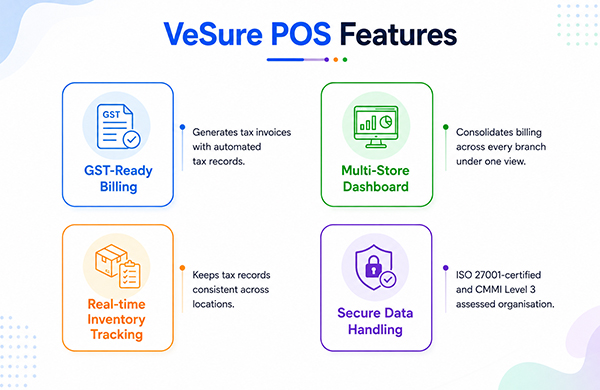
VeSure POS was built around the reality that Indian retailers and restaurant owners do not have time to babysit compliance software. The GST-ready billing module generates tax invoices with automated tax records as part of the normal checkout flow, so cashiers and staff keep working exactly as they do today, without learning a new screen.
For multi-outlet retail chains and restaurant groups, this matters more than it might seem at first. VeSure POS’s multi-store dashboard consolidates billing across every branch under one view, which is exactly the kind of visibility you need to track aggregate turnover correctly across a single PAN instead of guessing branch by branch. Combined with real-time inventory tracking and barcode-based billing, the same system that speeds up your counter also keeps your tax records consistent across locations.
This is important here because GST and financial billing data are inherently sensitive in nature, and VeSure Technologies is an ISO 27001-certified and CMMI Level 3 assessed organisation. A compliance tool is only effective if the data which underpins it is securely built and certified and this certification reflects how the systems backing that data are both created and audited not simply a page in a brochure.
A Real-World Scenario: A Three-Outlet Restaurant Group in Delhi NCR
Consider a restaurant group running three outlets across South Delhi and Gurugram, each individually billing under ₹2 crore a year. Combined under one PAN, the group crossed ₹6 crore last financial year, largely due to a corporate catering contract and a tie-up supplying packaged meals to a nearby IT park. None of that revenue looked unusual daily. It simply added up.
Before moving to an integrated system, the group’s accountant was manually flagging which invoices counted as B2B and trying to upload them to the IRP separately from the regular billing software, a process that occasionally got missed during busy weekends. After switching to VeSure POS, every applicable invoice routes through e-invoicing automatically at the point of billing, the new financial year’s document series resets without manual intervention, and the owner can see aggregate turnover across all three outlets from a single dashboard instead of three separate ledgers.
What to Do Before Your Next Invoice
Run through this before you raise another B2B invoice:
- Check your aggregate turnover across every GSTIN under your PAN for every financial year since 2017-18, not just the current year.
- Separate your B2B exposure from pure B2C sales: catering contracts, corporate accounts, institutional buyers, and exports all count.
- Confirm your billing software can generate an IRN in real time. If it cannot connect to the IRP directly, it is not compliant, regardless of how good the invoice looks.
- If your turnover is above ₹10 crore, make sure your software reports to the IRP within 30 days of the invoice date, since late uploads get rejected outright.
- Start your new financial year’s invoice, debit note, and credit note series fresh, rather than continuing last year’s numbering.
- If you are between ₹2 crore and ₹5 crore, treat this as a planning year. The threshold has been lowered multiple times since 2020, and the direction of travel is clear.
Conclusion
Conceptually, the ₹5 crore e-invoicing rule is not novel, but it is trapping several retail, restauran,t and pharmacy chainthatan most owners appreciate primarily because turnover is read cumulative and in total across all branches under one PAN. Once you've followed the breadcrumbs, the fix itself is simple: identify your actual aggregate turnover level, keep B2B invoices separate from B2C, and integrate with the government IRP into whatever software generates your bills. When you get this right, it safeguards your buyers' ITC claims, keeps your filings clean, and avoids a conversation around penalties which you do not want to get into.
Frequently Asked Questions
What is GST e-invoicing in simple terms?
GST e-Invoicing is an electronic system to validate B2B invoice before it becomes the valid document as it needs to be validated from Government side through Invoice Registration portal (IRP) before it can be passed on. As you do normally, your software creates the invoice and then the portal generates an Invoice Reference Number and QR code which authenticates it.
Who needs to follow e-invoicing rules in 2026?
Businesses with an aggregate annual turnover exceeding ₹5 crore in any financial year since 2017-18 are required to generate e-invoices for applicable B2B transactions, exports, and credit or debit notes. This applies even if your turnover has since dropped below ₹5 crore, and it is calculated across all branches under one PAN, not per outlet.
What happens if an invoice is issued without an IRN?
If this amendment is not made, the invoice will be treated as invalid under GST law (i.e. it was never issued). The buyer also cannot take Input Tax Credit on it, and the penalty is ₹10,000 or 100% of the tax due whichever is higher charged per incorrect bill.
Does e-invoicing apply to restaurants that mostly serve walk-in customers?
While your B2C sales (direct sales to walk-in diners) can largely be left out of the equation for the time being, a bulk of restaurant businesses also have some form of B2B exposure via catering contracts, corporate accounts or aggregator tie-ups. If the aggregate turnover exceeds ₹5 crore, they should e-invoice only these particular B2B invoices even if 99 per cent of daily sales are B2C.
Can an e-invoice be cancelled after it has been generated?
Yes, an e-invoice can be cancelled on the IRP within 24 hours of its generation. After that window, cancellation is no longer possible, and you would need to issue a credit note instead and report that credit note to the IRP separately.
How does VeSure POS help with GST e-invoicing compliance?
VeSure POS generates GST-ready invoices with automated tax records at the point of billing and is built to handle real-time tax compliance as part of normal checkout, without requiring staff to learn a separate process. For multi-outlet retailers and restaurant groups, its multi-store dashboard also makes it easier to track combined turnover across branches under one PAN, which is exactly what the ₹5 crore threshold is based on.
Not sure if your current billing setup is e-invoicing ready? Talk to VeSure Technologies about a GST-ready POS system built for Indian retailers and restaurants. Book a free demo of VeSure POS and see how compliant billing fits into your existing workflow.