Running a five-person startup is easy. Attendance is whoever shows up, payroll is one founder doing quick math on a Friday, and leave requests happen over WhatsApp. Nobody's complaining.
Cross into 20, 30, 50 people, though, and that same setup starts costing real time. Someone's chasing a leave approval that got lost in a chat thread. Payroll takes an entire afternoon instead of twenty minutes, and there's always one number that doesn't add up.
This is usually the point founders start actively looking for HR software for startups instead of patching things together for one more quarter.
That search is exactly why HR automation has become increasingly important for growing Indian startups. A good HRMS doesn't just save time — it takes the guesswork out of payroll, attendance, leave management, employee records, and routine HR administration.
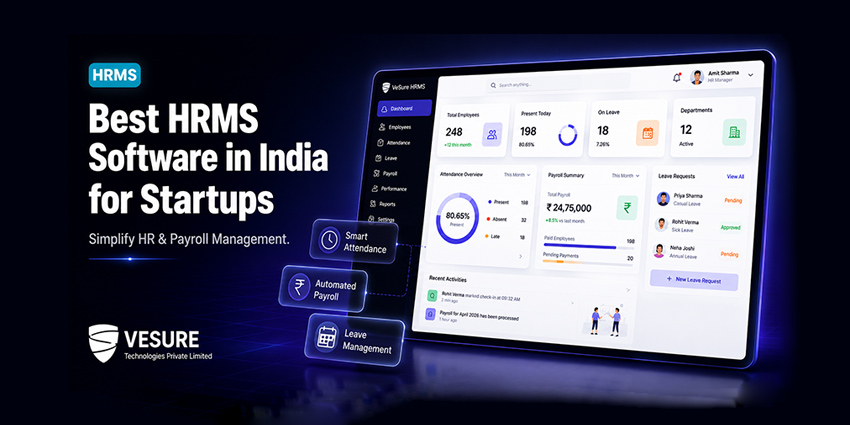
VeSure SaaS-based HRMS was built with this stage of company in mind. It's not a scaled-down enterprise tool — it's payroll, attendance, leave, and employee records in one platform, made for teams that are growing fast and don't have a dedicated HR ops function yet.
Quick Answer: What Is the Best HR Software for Startups?
The best HR software for startups is not necessarily the one with the longest feature list. It's the one that handles the HR tasks your team actually needs, is easy to implement, keeps employee and payroll information organized, supports Indian requirements, and can continue working as your startup grows.
For most growing startups, the essential capabilities include:
- Employee management
- Attendance tracking
- Leave management
- Payroll processing
- Employee self-service
- Reporting and analytics
- Mobile or cloud accessibility
- Data security
- Scalability
- Support for applicable Indian payroll and compliance requirements
The right choice depends on your team size, HR processes, payroll requirements, locations, and expected growth.
What Is HR Software for Startups?
HR software for startups is a digital system that helps growing companies manage employee-related processes without relying heavily on spreadsheets, paper records, emails, or group chats.
Instead of maintaining employee information in different places, startups can bring important HR workflows into one centralized system.
That can include:
- Employee records
- Attendance
- Leave requests and approvals
- Payroll
- Payslips
- Employee self-service
- Reports
- Shift management
- HR administration
The goal isn't to make HR more complicated. It's the opposite: take repetitive work off someone's plate before it starts consuming time that should be spent on hiring, people management, and growing the business.
Why Do Startups Need HRMS Software?
A startup can manage HR manually when the team is tiny. The problem starts when employee numbers grow faster than the process behind them.
Employee Attendance Tracking
Once a team crosses a certain size, tracking attendance by hand stops being realistic. HRMS software can automate attendance tracking and give managers visibility into working hours without someone maintaining a register or spreadsheet.
Payroll Management
Payroll is one of the more stressful recurring tasks for any startup — one wrong number and you've got an unhappy employee and a scramble to fix it.
HRMS software can streamline salary calculations, deductions, and payslip generation, reducing the amount of repetitive manual work involved in payroll.
Leave Management
Employees apply online, managers approve with a couple of clicks, and there's an actual record of it.
No more digging through chat history to confirm who requested leave or whether a manager approved it.
Less Repetitive Work for HR
Automation takes routine administration off someone's plate, freeing them to focus on hiring, employee engagement, culture, and the things that need human judgment rather than data entry.
A Better Employee Experience
A self-service portal gives employees access to routine HR activities without requiring HR to handle every small request.
Employees can check attendance, access payslips, or apply for leave when they need to.
What Should Startups Look for in HR Software?
Choosing HR software isn't about checking the biggest number of features. It's about finding the features that solve today's problems without creating tomorrow's.
Here are the capabilities startups should evaluate before choosing an HRMS.
|
Feature |
Why It Matters for Startups |
|
Employee Management |
Keeps employee information centralized and organized |
|
Attendance Management |
Reduces manual attendance tracking |
|
Leave Management |
Makes requests and approvals easier to manage |
|
Payroll Automation |
Reduces repetitive payroll calculations and manual work |
|
Employee Self-Service |
Lets employees handle routine HR requests themselves |
|
Mobile Accessibility |
Makes HR information accessible beyond a single office computer |
|
Reports & Analytics |
Gives managers useful workforce information |
|
Data Security |
Helps protect employee and payroll information |
|
Scalability |
Allows the system to support a growing workforce |
|
Customer Support |
Provides assistance when important HR processes need attention |
A startup doesn't necessarily need every HR feature available in the market. It needs the right HR features at the right stage of growth.
HRIS vs HRMS vs HR Software: What's the Difference?
These terms often get used interchangeably, which can make choosing HR technology more confusing than it needs to be.
-
HR Software
HR software is the broad term for technology used to manage HR activities such as employee information, attendance, leave, payroll, and reporting.
-
HRIS
HRIS for startups generally refers to a Human Resources Information System focused on organizing employee information and core HR processes.
-
HRMS
HRMS stands for Human Resource Management System. It typically covers a broader set of HR workflows, such as employee management, attendance, leave, payroll, employee self-service, and reporting.
For startups, the terminology matters less than the actual capabilities.
Instead of asking only, "Is this an HRIS or HRMS?", ask:
Can this system handle the HR processes my startup needs today — and still support us when the team grows?
How HRMS Helps Indian Startups
For Indian startups, HR management comes with its own set of administrative and payroll requirements. As the team grows, manually tracking employee information, attendance, salary calculations, leave, and applicable deductions becomes increasingly difficult.
A suitable HRMS for startups in India helps bring these processes into one organized platform.
The biggest benefits include:
-
Centralized Employee Information
Instead of employee records being scattered across spreadsheets, documents, emails, and folders, HR teams can manage information from one system.
-
Streamlined Payroll
Automating repetitive salary calculations and payroll processes can reduce manual work and make payroll easier to manage.
-
Easier Attendance and Leave Tracking
Attendance and leave information can be maintained digitally, making it easier for employees and managers to access and manage routine requests.
-
Employee Self-Service
Employees don't have to depend on HR for every basic request. Self-service capabilities can reduce administrative workload while improving accessibility.
-
Better Workforce Visibility
Reports and real-time information give managers a clearer view of attendance, leave, and workforce activity.
-
Support for Growth
A process that works for 20 employees should ideally continue working when the team reaches 50 or 100.
That's where scalability becomes important.
When Should a Startup Start Using HR Software?
There isn't one employee count at which every startup suddenly needs an HRMS.
The better question is:
When does manual HR management start taking more time than it should?
Some common signs include:
- Payroll takes hours to complete
- Employee records are spread across multiple spreadsheets
- Leave approvals happen through WhatsApp or email
- Attendance requires manual follow-up
- Employees repeatedly ask HR for payslips or basic information
- HR spends too much time on repetitive administration
- Management lacks a clear view of workforce data
- The team is growing quickly
- Payroll or compliance-related tasks are becoming harder to manage
If several of these are already happening, continuing with manual processes may create more work than adopting HR software.
HR Software Checklist for Startups
Before choosing an HRMS, use this simple checklist.
Core HR
- Centralized employee records
- Employee information management
- Attendance tracking
- Leave management
- Shift management
Payroll
- Salary processing
- Deductions
- Payslip generation
- Applicable statutory requirements
Employee Experience
- Employee self-service
- Easy access to HR information
- Mobile accessibility
Management
- Reports and analytics
- Workforce visibility
- Real-time information
Technology
- Cloud-based access
- Data security
- Scalability
- Customer support
- Easy implementation
The more closely an HRMS matches your actual workflow, the more useful it is likely to be.
What Affects HR Software Cost for Startups?
The cost of HR software can vary significantly depending on what a startup needs.
Instead of choosing software only by the lowest price, startups should consider the total value and the capabilities included.
Factors that can affect HR software cost include:
- Number of employees
- HR modules required
- Payroll requirements
- Number of locations
- Integrations
- Implementation requirements
- Customization
- Customer support
- Subscription model
For a startup, the cheapest option isn't automatically the best option if it creates more manual work or requires changing systems again as the business grows.
The better question is:
Does the HR software provide the capabilities we need today and enough flexibility for tomorrow?
How to Choose the Right HRMS for Your Startup
Choosing HRMS software for a startup becomes easier when you evaluate it against your actual business requirements.
1. Start With Your Current HR Problems
Don't begin with a feature list.
Start with the problems.
Is payroll taking too long? Is attendance manual? Are leave requests scattered across messages? Are employee records difficult to find?
Your answers should determine what you prioritize.
2. Identify Your Must-Have Features
For most growing startups, employee management, attendance, leave, payroll, employee self-service, reporting, security, and scalability are a strong starting point.
3. Think Beyond Your Current Team Size
An HRMS that works for a small team should not become a bottleneck when your workforce expands.
Check how the system handles growth before you need it.
4. Consider the Employee Experience
HR software isn't only for HR.
Employees and managers interact with the system too, so ease of use matters.
5. Evaluate Security and Support
Employee records and payroll information are sensitive business data.
Security and responsive customer support should be part of the evaluation, not an afterthought.
6. Look at the Complete Workflow
A long feature list doesn't automatically mean better HR software.
What matters is whether the features work together to reduce manual HR work.
Why VeSure HRMS Fits Startup Requirements
If you're looking for the best HRMS for startups in India, The Trusted SaaS Based Software Company provides VeSure HRMS is designed around the practical requirements of growing teams.
It's built to give startups a centralized platform for managing everyday HR operations without turning HR administration into another complicated system to maintain.
What VeSure HRMS Brings Together
|
Startup Requirement |
VeSure HRMS |
|
Employee Management |
✓ |
|
Attendance Management |
✓ |
|
Leave Management |
✓ |
|
Payroll Management |
✓ |
|
Employee Self-Service |
✓ |
|
Cloud-Based Access |
✓ |
|
Reporting |
✓ |
|
Scalability |
✓ |
|
Indian Payroll Requirements |
✓* |
*Applicable capabilities should be evaluated based on the startup's specific payroll and compliance requirements.
Why Startups Can Consider VeSure HRMS
- Simple employee management without a steep learning curve
- Attendance and payroll managed within one platform
- Cloud-based access for modern teams
- Leave management without scattered manual requests
- Employee self-service capabilities
- Real-time workforce visibility
- Designed for early-stage and growing teams
The idea is simple: your HR system should remove work, not create more of it.
What Makes HRMS Software Reliable?
A good HRMS isn't defined only by how many modules it has.
-
Ease of Use
A system your team can actually use is more valuable than a complicated platform filled with features nobody touches.
-
Scalability
What works at 20 employees should ideally continue working at 100. Switching HR systems during a growth phase can create unnecessary disruption.
-
Customer Support
When payroll is due and something isn't working, getting a useful answer quickly matters.
-
Secure Data Handling
Employee records and payroll information need to be handled securely.
-
Practical Automation
The best automation is the kind that removes repetitive work without making everyday processes harder.
Benefits of Using HRMS Software for Startups
Saves Time
Automating repetitive HR tasks reduces the amount of time spent maintaining spreadsheets and manually processing routine requests.
Reduces Administrative Work
HR can spend less time chasing attendance, leave approvals, records, and payroll information.
Helps Reduce Payroll Errors
Automated calculations can reduce the risks associated with repeated manual data entry.
Improves Workforce Management
Centralized attendance, leave, employee, and reporting information gives managers better visibility.
Improves Employee Experience
Employees can access routine HR services themselves instead of depending on HR for every request.
Supports Business Growth
A cloud-based HRMS can provide a more structured HR foundation as the startup grows.
Read Article - What Is Cloud-Based HR Software?
Cloud HRMS vs. Traditional HR Management
The difference isn't simply about moving paperwork online.
It's about changing how HR work gets done.
|
Traditional HR Management |
Cloud HRMS |
|
Manual attendance tracking |
Automated attendance workflows |
|
Spreadsheet-based payroll |
Streamlined payroll processing |
|
Scattered employee records |
Centralized employee information |
|
Leave requests through messages |
Digital leave requests and approvals |
|
Delayed information |
Real-time information |
|
Repetitive administrative work |
Automated workflows |
|
Limited accessibility |
Access from anywhere |
|
Higher administrative overhead |
Reduced repetitive work |
For growing startups, that difference can become significant as the workforce expands.
Final Thoughts: Is HRMS Worth It for a Startup?
Managing HR manually works when the team is small.
It becomes harder when growth outpaces what a spreadsheet, email inbox, and group chat can handle.
That's where HRMS for startups becomes useful.
A good HRMS brings employee records, payroll, attendance, leave, and other HR workflows into one organized system. More importantly, it gives startups a way to build repeatable HR processes before administrative complexity starts slowing down growth.
The best HR software for a startup isn't simply the platform with the most features.
It's the one that fits the company's current needs, is easy for employees and managers to use, supports important HR processes, and can grow with the business.
VeSure HRMS helps startups automate everyday HR work, reduce manual effort, and give employees a more convenient self-service experience.
FAQs for HRMS Software for Startups in India
What's the best HR software for startups in India?
The best HR software depends on the startup's team size, HR processes, payroll requirements, and growth plans. Look for a system that is easy to use, scalable, secure, and capable of managing essential processes such as employee records, attendance, leave, payroll, and employee self-service.
Which HRMS is best for a startup?
The right HRMS is one that matches the startup's actual requirements rather than simply offering the largest number of features. Startups should evaluate employee management, attendance, leave, payroll, reporting, security, ease of use, support, and scalability. Solutions such as Vesure HRMS Software can help startups streamline these essential HR processes while providing the flexibility needed as the business grows.
What HR software do Indian startups need first?
Most growing startups should start with the HR processes that consume the most manual time — employee records, attendance, leave, payroll, employee self-service, and reporting. The exact requirements depend on the company's size and operating model.
When should a startup start using HR software?
There is no fixed employee count. A startup should consider HR software when manual attendance, payroll, employee records, leave management, or HR administration starts consuming significant time or creating errors.
Is HRMS useful for small startups?
Yes. HRMS can be particularly useful for smaller teams because they often have limited HR resources. Automating repetitive administrative work allows a small team to manage HR processes more efficiently.
What features should startups look for in HR software?
Startups should evaluate employee management, attendance, leave management, payroll, employee self-service, reporting, mobile or cloud access, data security, scalability, and customer support.
How much does HR software cost for startups in India?
HR software cost depends on factors such as employee count, modules, payroll requirements, integrations, implementation, support, customization, and subscription model. Startups should evaluate the overall value and scalability of a solution rather than choosing only on the lowest cost.
What is the difference between HRIS and HRMS?
HRIS generally focuses on employee information and core HR processes, while HRMS can cover a broader range of HR workflows such as attendance, leave, payroll, employee self-service, and reporting. In practice, the terminology varies between software providers.
How does HRMS help Indian startups?
HRMS helps Indian startups centralize employee records, streamline attendance and leave management, simplify payroll processes, provide employee self-service, improve workforce visibility, and reduce repetitive administrative work.
Is cloud-based HR software good for startups?
Cloud-based HR software can be useful for startups because it allows HR information and workflows to be accessed without relying on a single office computer. It can also support modern, distributed, remote, and hybrid teams.
Can startups manage payroll through HRMS?
Yes. HRMS platforms can provide payroll capabilities such as salary calculations, deductions, and payslip generation. Startups should verify that the specific system supports the payroll and statutory requirements applicable to their organization.
Can HR software scale as a startup grows?
A scalable HRMS should continue supporting a growing workforce without forcing the company to completely change its HR processes. Startups should evaluate scalability before selecting a system.
Why should startups consider VeSure HRMS?
VeSure HRMS brings employee management, attendance, leave, payroll, employee self-service, cloud access, and reporting into one platform. It is designed around the practical HR requirements of early-stage and growing teams.
Ready to Simplify Your Startup's HR?
Stop letting spreadsheets, scattered records, and repetitive HR requests slow down your team.
Book a demo with VeSure HRMS and see how your startup can manage everyday HR operations from one platform.