

Almost all Indian businesses with an intention to sell online take the same route: go on Amazon, Flipkart, or Meesho, and get traffic from the marketplace. Until the commission bills come for margin, the brand gets swallowed by someone else's app, and there is no way at all to talk directly with the person who just bought from them.
The alternative many business owners overlook is simpler than it sounds: a dedicated online store that carries your own brand, your own domain, and your own customer data. Here's what actually goes into building one, and what DiGiMall handles at each step.
Quick Answer
DiGiMall is a multivendor marketplace, it is VeSure's step 1 to launch the branded online store. The startup provides a single business owner with a template-based storefront, product catalog, integrated payment gateway, order and inventory tracking built into a point-of-sale (POS), as well as WhatsApp integration so that any retailer, direct-to-consumer (D2C) brand or service business can go online without needing to hire developers and have sales sliced at third-party marketplaces.
What an Online Store Platform Actually Needs to Do
An e-commerce website platform is not merely a product listing page. To work like an actual online store, it has to juggle four things at the same time: a storefront that matches your branding, a product catalogue that's easy for you to update, a way to take payments and record orders, and stock numbers that are kept up-to-date as sales come in.
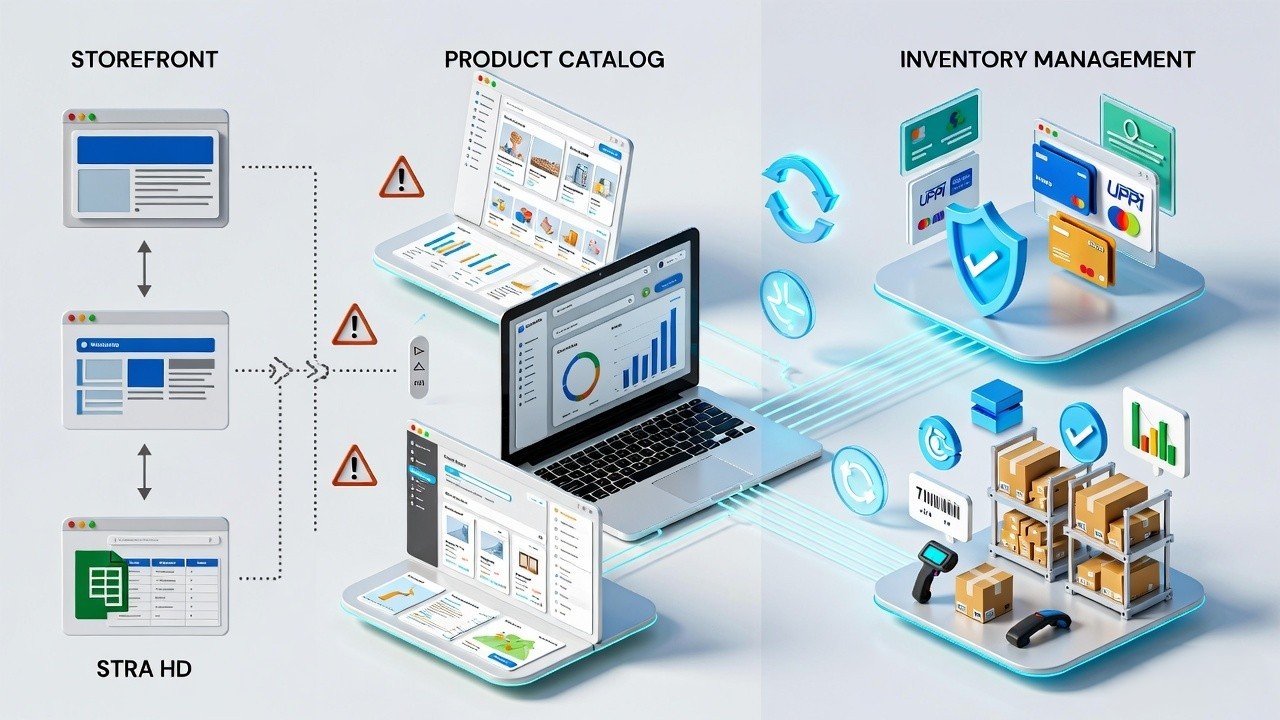
The vast majority of companies that attempt to cobble this together for themselves eventually end up sewing together a website builder, an independent payment processor, and a spreadsheet for stock until the order volume outgrows what one person can keep track of manually.
An interconnected e-commerce platform ties all four elements together into a single solution, so a business owner can manage products, payments, and inventory from a single tool instead of three separate applications.
Why Marketplace-Only Selling Eventually Costs More Than It Looks Like
Having a Marketplace of this size to immediately list on is the easiest way to get your products in front of buyers, and it will definitely help any new sellers without any traffic already. The cost shows up later. Every sale is limited by commission and platform fees.
The seller has nothing to say about their products being stacked next to dozens of similar-looking listings. More importantly, the customer relationship is owned by the marketplace; buyer data, repeat-purchase behaviour, and point-of-contact are all with a platform - and not the brand that completed a sale.
It is exactly this reason only due to which local retail associations and D2C brand groups, even small shop owners across all genres from fashion to electronics and home decor are starting to create their own branded storefronts along vs marketplaces not instead of them. It gives them a channel where they control the margin, own the customer data, and are not competing with five other sellers of essentially the same product in a race to see who can sell it for cheaper.
Step 1: Choosing a Template and Setting up Your Storefront
The second real choice is what the storefront looks like and how fast it can be up. DiGiMall has several pre-built themes that a small business owner can choose and customize without needing to code or hire a designer, choosing colours from palettes and adding layout elements & branding components so that the store represents the business instead of looking like any generic template.
VeSure positions this as a same-day setup: choose a theme, add branding, and the storefront structure is ready before the product catalogue is even finished.
Step 2: Building the Product Catalogue
Following that, the store needs merchandise. That means listing your products with images, prices, descriptions, and quantities in stock, as well as categorizing them so customers can actually find what they want.
A fashion or jewellery seller with multiple SKUs per design isn't constrained to flat, single-variant listings as you might be on many basic store builders. DiGiMall supports unlimited product variables (size, colour, material, and other variants)
Step 3: Payments, Orders, and Inventory in One Place
A storefront does not work, in practice, until it gets money into your bank account and ships product. DiGiMall combines a variety of payment methods, including credit cards and wallets like Paytm, so customers have familiar, safe checkout choices. The orders and stock information are tracked in real time from the same dashboard to manage his/her catalogue, which is what prevents a seller from that common problem of selling out-of-stock products.
This is one item that may be worth calling out for those who are platform-agnostic: DiGiMall operates on a 0% platform transaction fee. The company pays for its monthly plan and standard payment-gateway charges, but DiGiMall itself doesn't take a cut from each sale - quite a different economic model from marketplaces which charge category-based commission on every order.
Step 4: Selling Beyond the Website: POS and WhatsApp Integration
For instance, even most Indian retail businesses are not only doing omnichannel. So while a boutique may have a physical counter, a D2C brand might be taking its orders on WhatsApp more than on its website. DiGiMall rectifies this with multichannel inventory management, providing DigiMall POS Pro bundled for FREE with every plan so you are billing in-store and processing online orders from the same inventory instead of two separate stock counts drifting apart over time.
Business Verification lets a business verify orders, updates, and queries via WhatsApp - the channel Indian buyers use every day.
The storefront is also immediately shipped as a free PWA - so the customer benefits from an app experience (fast loading, works well on mobile data, add to home screen) without the business having to go through the trouble of building and supporting a native app.
What's Actually Included on Each DiGiMall Plan
DiGiMall is priced by catalogue size and number of user accounts rather than by feature tier, which keeps the core toolkit consistent across plans:
- Starter - ₹999/month: 1 user account, up to 50 products
- Advanced - ₹1,999/month: 2 user accounts, up to 100 products (VeSure's recommended plan for most growing sellers)
- Premium - ₹4,500/month: a customized setup for businesses with specific catalogue or team-size requirements
Every plan, including Starter, includes unlimited product variables, multiple shipping methods, a custom domain, the free PWA, a free blog page, customer wallet, custom additional pages, WhatsApp integration, 0% platform transaction fee, a free SSL certificate, DigiMall POS Pro, and 24/7 support. The difference between plans is catalogue size and team access, not which core features a business can use.
Use Case: A Boutique Fashion Label Builds a Direct-to-Customer Channel
A fashion label that had been selling exclusively through two large marketplaces wanted to have a way of importing customers and reducing the commission they paid back on each sale, and someone who could get repeat purchases instead of one-off marketplace buyers.
The brand chose a fashion theme with DiGiMall, uploaded its entire catalogue complete with size and colour variants, and enabled WhatsApp so that customers could question fit or fabric before making an order.
The marketplace listings remained up and continued to acquire new customers. However, having a branded store allowed for repeat buyers and follow-ups via email or WhatsApp, eventually generating sales at 100% margin - things that could only be done inside someone else's marketplace app.
How to Get Started with DiGiMall
When it comes to choosing a plan, it mostly boils down to catalogue size. Starter is for a company with fewer than 50 SKUs, where one person handles the store. Advanced is even a better fit with its shorter catalogue and smaller team. Premium is a better fit for businesses with specific integration or scale needs. After that, the setup proceeds in the same order as outlined above: choose your theme, create your catalogue, set up payments, and you can go live (for the most part) without engaging a developer at every step.
Conclusion
Branded online store: The DiGiMall is not a multi-seller marketplace where sellers can register to sell under the same platform. It is a means for one business to claim an online storefront, a domain, and a direct customer relationship that a marketplace listing can never provide. DiGiMall does just that for retailers (D2C brands and service businesses), across fashion, electronics, home decor, jewellery and food categories - storefront + catalogue + payments + POS + WhatsApp in one system.
Frequently Asked Questions
What is DiGiMall?
DiGiMall is an e-commerce website platform developed by VeSure Technologies through which a business can open, operate, and grow its own online store. A single system that contains storefront templates, product catalogue management, payment gateway integration, tracking orders and inventory, along with POS & WhatsApp integration.
Is DiGiMall a multi-vendor marketplace platform?
No. DiGiMall is built for a single business to run its own branded online store, not for multiple independent sellers to list under one shared marketplace. Each DiGiMall account represents one business's storefront, catalogue, and checkout.
How long does it take to launch a store with DiGiMall?
DiGiMall is designed for fast setup: select a template, add branding, and the storefront structure is ready quickly, without needing design or coding skills. Actual go-live time depends mainly on how long it takes the business to add its full product catalogue.
What payment methods does DiGiMall support?
DiGiMall supports multiple payment gateways, including credit cards, Paytm, and other digital wallets, so customers can choose a familiar and secure checkout option.
Can I sell in-store and online at the same time with DiGiMall?
Yes. Every DiGiMall plan includes DigiMall POS Pro at no extra cost, so in-store billing and online orders share the same product and inventory data instead of being tracked separately.
What's the difference between the DiGiMall Starter and Advanced plans?
The core toolkit is the same on both plans. Starter (₹999/month) supports 1 user account and up to 50 products, while Advanced (₹1,999/month) - VeSure's recommended plan for most growing sellers - supports 2 user accounts and up to 100 products.
Ready to see this in action? Book a free demo at
vesuretech.com/book-a-demo - VeSure Technologies Private Limited.