Sell a bag of rice and generic billing software works fine - quantity, price, done. Sell a phone or a television, and that same software has no idea it just handed over a product with a serial number, a warranty clock that started ticking, and possibly an EMI scheme attached to it.
This is almost exactly the mismatch that most of the electronics & mobile store owners in India are running into, with retail billing software developed for grocery-style transactions forced onto a category that desperately requires anything but.
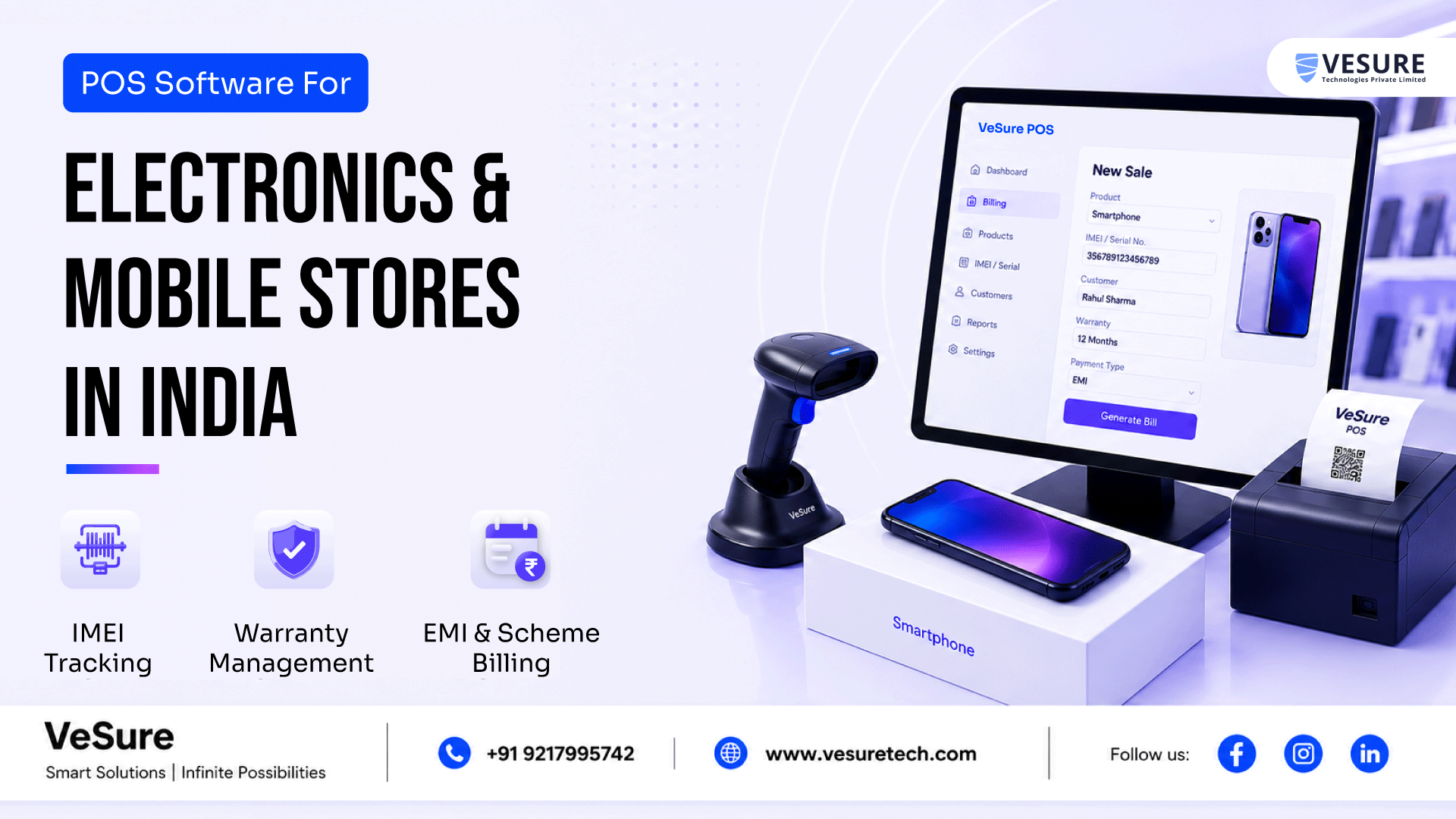
Quick Answer: POS software for electronics and mobile stores must record IMEI or serial numbers at the moment of billing, automatically associate warranty periods to that unit alone, apply GST slabs on categories accurately, and enable EMI or scheme-based billing.
Generic POS or manual billing can’t do this reliably, which creates warranty disputes, GST errors, and no traceable record if a device is returned or claimed under warranty.
What Makes Electronics Retail Billing Different?
A grocery sale ends the moment the bill is printed. An electronics sale doesn’t; it opens a warranty period, sometimes an EMI repayment schedule, and occasionally a manufacturer’s after-sales claim that will come back to the store months later.
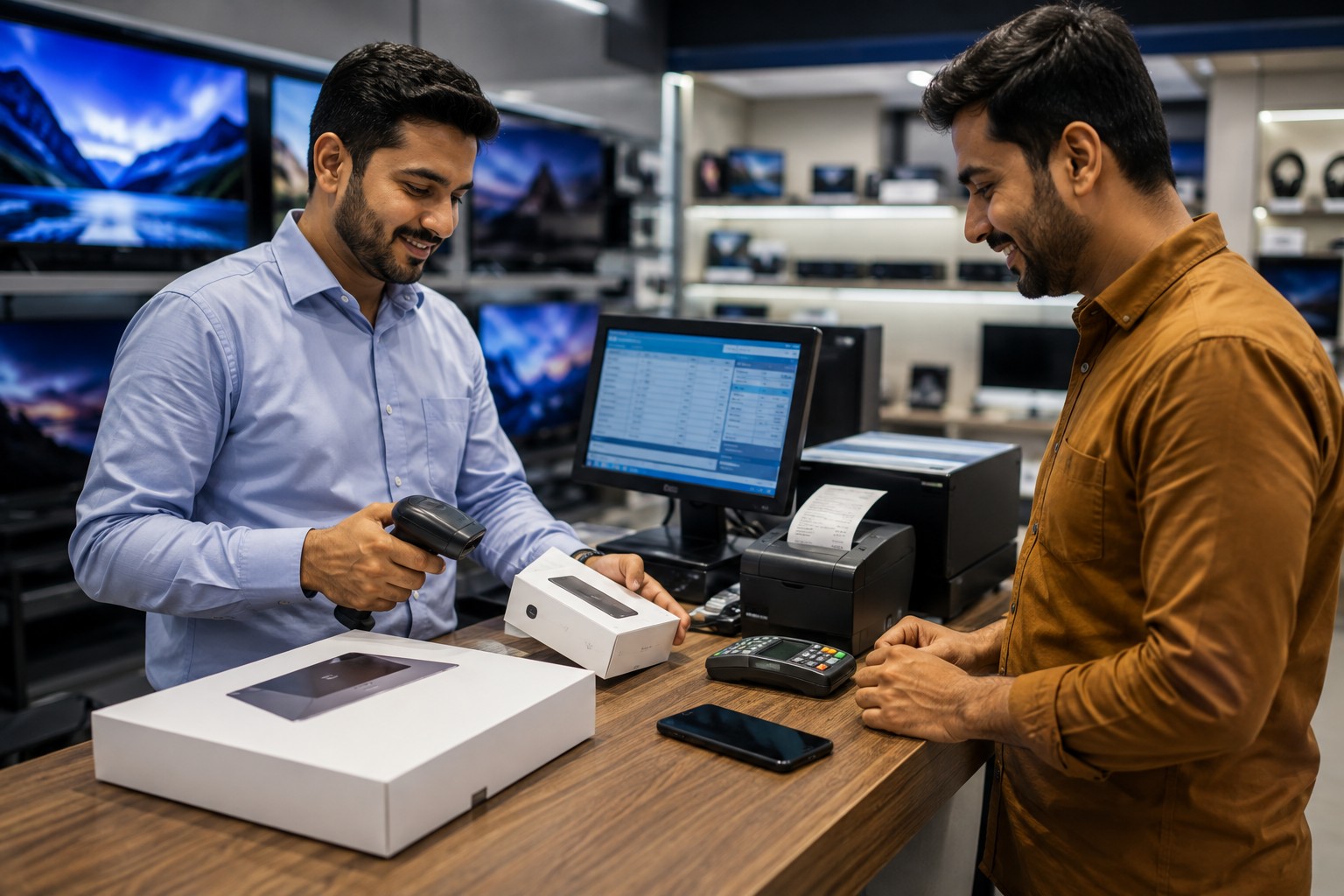
The billing system must recall details the customer themselves may forget: which unit (identified by IMEI or serial number) was bought on what date, under what warranty term, and whether GST applied correctly to that product category.
Why Generic Billing Software Fails Electronics Retailers
A store that does not capture serial or IMEI at billing has no way to prove which unit a customer purchased in the event of a warranty dispute starting after the transaction; each unit of the same model looks identical on an invoice, full stop. If warranty periods are tracked at all, they often exist as a column on some notebook or spreadsheet the staff has to come back and update manually (which means they usually don’t).
GST adds another layer of complexity to this - electronics and mobile phones fall under notoriously complicated (and different) slabs compared with other retail categories, and manual billing makes misclassification even more likely. And EMI (or exchange-scheme) sales - increasingly commonplace for phones and appliances in India- require a bill that reflects the terms of the scheme (even small details like inclusive or exclusive of taxes), which is something vanilla POS systems are rarely good at.
The impact manifests itself later, not at the register: a shopper returns with a “faulty” unit and the store is unable to verify date of purchase or model compatibility in real time; a GST audit raises questions about inconsistent tax application across similar products; an EMI provider contests a scheme sale because the invoice did not properly reflect terms.
How Serial/IMEI Capture Should Work at Billing
It's not a separate warranty register; the solution is actually capturing serial + IMEI as part of the billing step so it will happen automatically and cannot be skipped. Now, when a phone comes in the door for billing, you or your employees scan or type in that IMEI right then and there - instantly connecting it all with the invoice, customer record, and start date of warranty.
Should a unit be returned or exchanged, or come back for such things as a warranty claim, the technicians reference the IMEI to retrieve that same sale rather than relying on a customer keeping hold of their physical receipt.
Category-Wise GST and EMI Billing Without Manual Workarounds
GST correctness for electronics comes from the billing system applying the right slab automatically based on product category, not from staff remembering which rate applies to which item type.
For EMI and scheme billing, the invoice needs to reflect the actual payment structure the customer agreed to, so there’s a clean paper trail if the financing partner or the customer disputes a repayment later.
How VeSure POS Handles This for Electronics and Mobile Retailers
VeSure POS captures serial and IMEI numbers directly at the point of billing, not as an optional add-on step, but as part of how a sale is recorded for relevant product categories. That number links automatically to the invoice, the warranty start date, and the customer record, so a warranty claim six months later can be verified in seconds instead of depending on a customer’s memory or a paper receipt.
GST is applied category-wise and automatically, so a mobile phone, an accessory, and a home appliance sold in the same transaction are each taxed at the correct slab without the cashier needing to manually select rates. VeSure POS also supports EMI and exchange-scheme billing, recording the scheme terms as part of the invoice, useful when a financing partner needs to verify a sale, or when a customer disputes the payment structure later.
Because it runs on VeSure’s multi-outlet architecture, a mobile or electronics chain with several branches can also see stock and serial-level inventory across every store from one dashboard, which matters for a category where fast-moving models go out of stock at one branch while sitting unsold at another.
Real Scenario: A Mobile Store Handling a Warranty Return
A customer walks in three months after buying a phone, claiming a manufacturing defect and asking for a warranty exchange. Without IMEI tracking tied to the sale, the store has to rely on the customer’s receipt (if they kept it) and take their word on the purchase date. With IMEI captured at billing, the staff searches the exact device number, and the system pulls up the original invoice, the sale date, and the warranty term instantly - resolving the dispute in the time it takes to type the number, not by digging through a stack of paper bills.
What to Look For in Electronics & Mobile Store POS Software
- Native IMEI/serial capture at billing - not a separate manual entry system.
- Automatic warranty linkage from the serial number to a tracked expiry date.
- Category-wise GST slabs applied without manual selection by staff.
- EMI and scheme billing support with terms recorded on the invoice.
- Multi-outlet stock visibility for chains carrying the same fast-moving models across branches.
Conclusion
There is also risk that extends beyond the sale itself in areas such as warranty claims, financing disputes, and scrutiny of GST if you are working in electronics and mobile retail. Bill software made for common retail simply wasn't organized to take that risk efficiently.
If the POS is embedded with captured IMEI, warranty-linked details, and GST information accurate to category, a walk-in months later - there is no hearsay involved.
Frequently Asked Questions
Why is IMEI tracking important for mobile store billing software?
Every phone sold is tracked against an IMEI, then linked back to an invoice and sale date, along with a warranty period so if that particular unit is returned or claimed under warranty at a later point in time instead of taking the customers word for it on their receipt or memory of when they bought it the store owner can instantly verify through your phones unique serial number where and when you purchased.
How does POS software apply GST correctly for electronics?
Category-aware POS software assigns the correct GST slab to each product type automatically at billing, based on how the item is classified in the system, removing the risk of a cashier manually applying the wrong rate during a busy sale.
Can EMI billing be handled directly in POS software?
Yes. POS systems built for electronics retail, like VeSure POS, can record EMI or scheme terms as part of the invoice itself, giving the store a clear reference if a financing partner or customer later disputes the payment structure.
What happens if a store doesn’t track warranty periods in its billing system?
Without a tracked warranty link, staff has to depend on the customer’s physical receipt to verify purchase date and eligibility, which slows down warranty claims and creates disputes when receipts are lost or unclear.
Is IMEI-based billing useful for stores selling more than just phones?
Yes, the same serial-tracking approach applies to appliances, laptops, and other serialized electronics where warranty and after-sales tracking matter, not just mobile phones.
Get Started
If warranty disputes and GST misclassification are recurring headaches at the counter, explore VeSure POS for electronics and mobile retail or book a demo to see IMEI-linked billing in action.