If you're running one salon or one clinic, you can get away with a lot. A paper register, a shared Google Sheet, even a WhatsApp group where staff shout out bookings — it's messy, but it mostly works because everyone can see the same physical calendar.
Open a second branch and that system quietly stops working. Nobody notices right away. Then one Tuesday afternoon, two clients show up at 4 PM for the same stylist, and you realize the two branches have been running on separate planets this whole time.
Quick Answer: Multi-location appointment management software puts every branch's booking data — staff availability, open slots, no-show history — into one system, instead of leaving each branch to manage its own calendar in isolation. Skip this, and chains almost always end up with double-bookings, no combined picture of how branches are actually performing, and no way to redirect a customer from a fully-booked branch to one that has open slots down the road.
What Is Multi-Location Appointment Management?
Think of it as the gap between "each branch has its own calendar" and "every branch is writing to the same calendar." For a single location, a shared calendar per staff member is fine — everyone's in the same room, more or less.
The moment you add a second branch, with its own staff, its own regulars, its own walk-in crowd, those calendars need to start talking to each other. That's especially true if clients ever book across locations, or if you, as the owner, want one honest view of how the whole business is doing rather than three separate stories from three separate managers.
Why Independent Branch Calendars Break Down at Scale
A few things go wrong, almost always in the same order.
Double-bookings creep in first — usually because two receptionists at two different branches (or even two staff members at the same branch on different tools) aren't seeing each other's updates in real time. Nobody's being careless; the systems just don't talk.
No-show tracking is the next casualty. A stylist or doctor who's racked up five no-shows this month at one branch can look completely fine on paper, because nobody's pulling that data together across locations. The pattern is invisible until it's a real problem.
And then there's the reporting gap. Without a combined view, an owner has no easy way to tell which branch is overbooked on a Saturday and which one has three open slots sitting unused. That matters a lot when someone calls branch A to book and branch A is slammed — ideally, that call turns into a booking at branch B instead of a lost customer.
How Centralized Scheduling Solves This
A centralized system closes these gaps in a few concrete ways, not through some abstract "digital transformation" pitch.
Conflict prevention happens automatically. Every branch writes to the same booking engine, so a staff member's slot gets locked the second it's booked — anywhere. Double-booking stops being a thing staff have to remember to check for; it just can't happen.
No-show patterns become visible chain-wide. A repeat no-show client doesn't get a clean slate just because they booked through a different branch this time. The pattern follows them, not the location.
Reporting stops being a manual chore. Instead of an owner calling three branch managers on a Friday to piece together how the week went, one login shows booking volume, staff utilization, and no-show rates side by side across every outlet.
How VeSure AMS Applies This for Salon and Clinic Chains
VeSure's Appointment Management System was built with multi-location appointment management in mind from the start — it isn't a single-location tool that got stretched to cover more branches.
Staff availability, appointment slots, and client records all sync centrally. A booking made at one branch shows up everywhere else instantly, so two receptionists working at two different locations at the same time aren't stepping on each other.
Reminders go out automatically, using the same rules at every branch, so no-show reduction doesn't depend on one particularly diligent receptionist remembering to follow up while another branch forgets.
Client records travel with the client rather than staying stuck at whichever branch they first walked into. That matters for chains where someone might book near their office one week and near their home the next — staff at either branch can pull up their history instead of starting from zero.
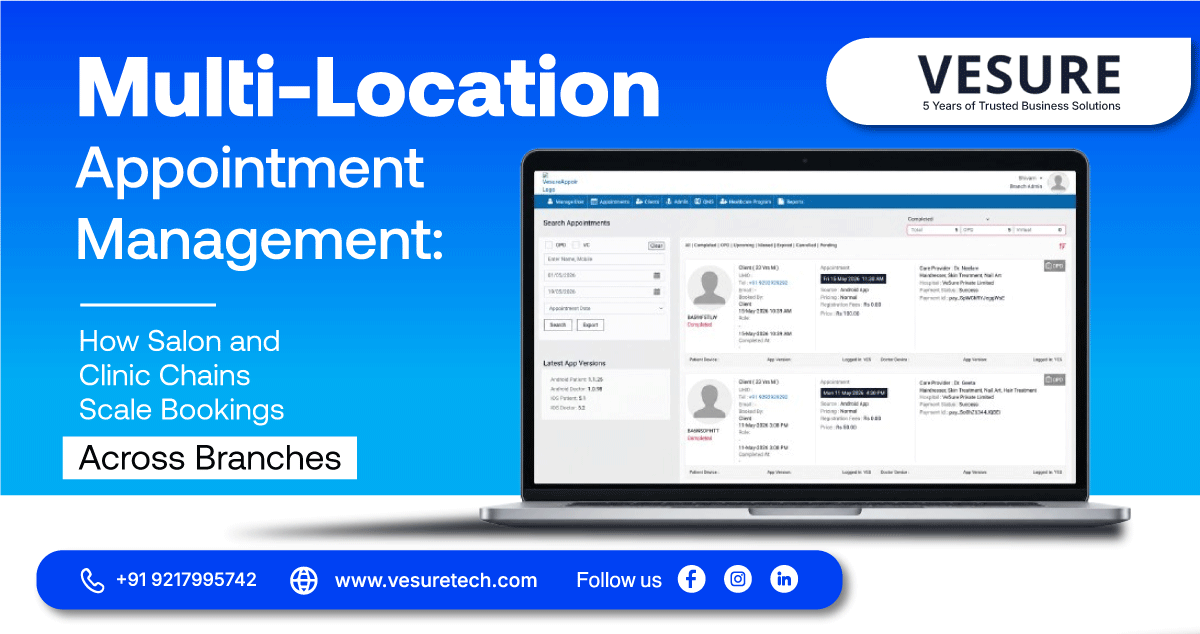
And because reporting lives in one place, an owner running three, five, or more branches gets a single dashboard for booking volume, cancellations, and staff utilization — no spreadsheet stitching required.
Real Scenario: A Salon Chain With Three Branches
Say a salon chain has three branches spread across the same city. Each one used to run its own booking register, its own way.
A regular client who usually visits the branch near her office decides, one day, to book at the branch near her house instead — she's working from home that day. On the old, disconnected system, that second branch has no idea who she is. No service history, no favorite stylist, no idea she's cancelled last-minute twice this year. As far as that branch is concerned, she's a stranger.
With a centralized system, the second branch pulls up her full record the moment her name goes into the system — preferred services, usual stylist, any pattern of late cancellations — and books her in without missing a beat.
Meanwhile, the chain owner can see that branch three is consistently quiet on weekday afternoons compared to the other two, and can put a promotional push exactly where it's needed instead of guessing.
How to Get Started With Multi-Location AMS
A few practical steps if you're considering the switch:
- Map where your current system is actually failing. Where are double-bookings happening? Where does no-show tracking break down between branches?
- Look for genuine real-time sync, not a system that updates every few hours or overnight.
- Migrate client history centrally, so any branch can see a client's full record instead of only their own slice of it.
- Standardize no-show and reminder rules across every location, rather than leaving it to individual staff discretion.
- Check the combined dashboard weekly, so an under-booked or over-booked branch gets caught early, not three months later.
Conclusion
No chain outgrows its booking system overnight. It happens branch by branch, slowly enough that nobody quite notices until double-bookings and disconnected client records just feel normal.
Centralizing appointment management isn't really about scale for its own sake — it's about making a multi-branch business actually function like one business, instead of a handful of locations that happen to share a logo. That's where working with the right SaaS software company makes the difference.
FAQs for Multi Location Appointment Software
How does multi-location appointment software prevent double-booking?
Every branch writes to the same central system in real time, so the moment a staff member's slot is booked anywhere, it's locked everywhere. Two branches booking the same person for the same time slot simply isn't possible.
Can client records be shared across branches of the same salon or clinic chain?
Yes. With a centralized system like VeSure's, a client's booking history, preferred staff, and service records follow them from branch to branch, so no location is starting from scratch with a returning client.
Does centralized appointment management help reduce no-shows?
It helps mainly by making patterns visible at the chain level. A client who's a repeat no-show at one branch doesn't get a clean slate at another, and automated reminders apply the same way everywhere rather than depending on one branch's habits.
Is multi-location AMS only useful for large chains?
No — the core problems (double-bookings, disconnected client history) start the moment a second branch opens. A two-location salon runs into the same issues as a ten-location one, just at a smaller scale.
What reporting does a multi-branch owner get with centralized AMS?
Typically booking volume, cancellation rates, no-show frequency, and staff utilization, all visible side by side across every branch from a single login — no manual data collection from each location required.
Get Started
If juggling separate calendars and disconnected client records across branches sounds familiar, take a look at VeSure's Appointment Management System or Book a demo to see what centralized multi-location appointment management looks like in practice.