The batch recall - it is the moment that every pharma operations head dreads, figuring out what lot went where, who sold it to which retailer, and how quickly it can all come back while a regulator watches the clock. If your team is still tracking this on spreadsheets, that call takes hours rather than minutes. The solution to this is enterprise resource planning (ERP) software that solves the problem by unifying production, inventory, compliance, and finance in one unified system rather than 5 disconnected systems.
The stakes are higher now too: from January 26, 2026, revised Schedule M rules under the Drugs and Cosmetics Rules, 1945 are being implemented across the nation, as manufacturers will be required to comply with global GMP standards. In this guide, we will go over what pharma-ready ERP software actually needs to do, and where VeSure ERP fits into this equation.
Quick Answer
The best ERP software solution for the Pharmaceutical Industry has additional specialized features along with generic accounting and inventory modules like batch-level traceability, regulatory compliance tracking (GMP, GDP, and Schedule M), real-time visibility of finished goods, and recall management of drug products. A variety of Integrate these with billing and HR on one dashboard while Manufacturers and distributors end up piecing together various tools for each function, are solvable through VeSure ERP.
Table of Contents
- What Is ERP Software for Pharmaceutical Companies?
- What Happens Without the Right ERP System?
- What Should Pharma - Ready ERP Software Actually Include?
- How VeSure ERP Helps Pharmaceutical Businesses
- A Distributor's Story: From Spreadsheets to One Dashboard
- How to Choose the Right ERP for Your Pharma Business
- Frequently Asked Questions
What Is ERP Software for Pharmaceutical Companies?
Enterprise resource planning (ERP) software integrates sales, inventory, manufacturing, finance, and HR on one connected system instead of separate tools that do not communicate with each other. For many businesses, that's time saved alone. However, more critically for a pharmaceutical is that, it provides an immutable record of every batch from raw material to pharmacy shelf.
Generic ERP for retail or general manufacturing rarely has this built in, but pharma-focused ERP needs batch & expiry tracking, serialization support, plus an audit trail and compliance workflow that are mapped to Indian drug regulations, which should not be an afterthought. Two years ago, it was less important; now, because Schedule M compliance checks are no longer just paper-driven processes. They are live inspections with penalties for non-compliant units.
What Happens Without the Right ERP System?
When there is no connected system, a mid-size pharma distributor usually operates sales across one tool, inventory in a spreadsheet, and accounts within a separate desktop program that nobody updates in real-time. The gap is most evident in a recall: somebody then has to manually check three files and even work out which batch number went to which retailer, all of which can take up an entire working day.
Or even in smaller shapes, yet every week - a near-expiry batch of stock is sitting quietly at the back of a warehouse because nobody flagged it; a compliance officer preparing for an inspection manually pulling records instead of exporting a report; or finance closing the month late since sales and inventory figures don't match.
On their own, none of these seem like a crisis. They are the difference between a pharma business that scales cleanly and one that hits a compliance wall when you open a second warehouse or add a third product line.
What Should Pharma-Ready ERP Software Actually Include?
Before shortlisting vendors, it helps to know what “pharma-ready” actually means in practice, not as a checklist to tick, but as day-to-day capability.
Compliance and Regulatory Tracking
Overview of the pharmaceutical industry in India. The Indian pharmaceutical industry is one of the most regulated sectors in India. An effective ERP will embed audit trails, electronic batch records and compliance with quality management workflows aligned to GMP, Good Distribution Practice (GDP) and Good Laboratory Practice (GLP), so that compliance emerges from normal usage of the system rather than being separated as an additional project each time an inspection is due.
Batch Traceability and Recall Readiness
The full chain from raw material to finished product through each stage of manufacturing and distribution has to be trackable end-to-end right up until the retailer sells it. Excellent batch management and serialization support means that if a recall is ever required, the affected units can be located and pulled away from the distribution chain in minutes, not days.
Supply Chain and Inventory Visibility
The solution enables real-time visibility into stock levels, demand forecasting and supplier relationships, reducing lead times and avoiding the two most common inventory failures in pharma - stock-outs on fast-moving medicines and expiry write-offs on slow-moving ones.
Quality Management
Deviation management, quality assurance workflows and standardised operating procedures (SOPs) need to reside within the same system as production and inventory so that any quality issue is logged, tracked and resolved without a parallel paper trail.
Data Security
Pharma companies handle sensitive data: patient information, formulations, and intellectual property. Look for role-based access controls, encryption, and routine backups as standard, not an add-on.
Put together, here's what to hold every shortlisted ERP vendor to:
- Audit trails and electronic batch records built in, not bolted on
- Workflows aligned to GMP, GDP, and Schedule M requirements
- Batch-wise traceability and serialization support for recall readiness
- Real-time inventory visibility with expiry and reorder alerts
- Role-based data security with encryption and audit logging
How VeSure ERP Helps Pharmaceutical Businesses
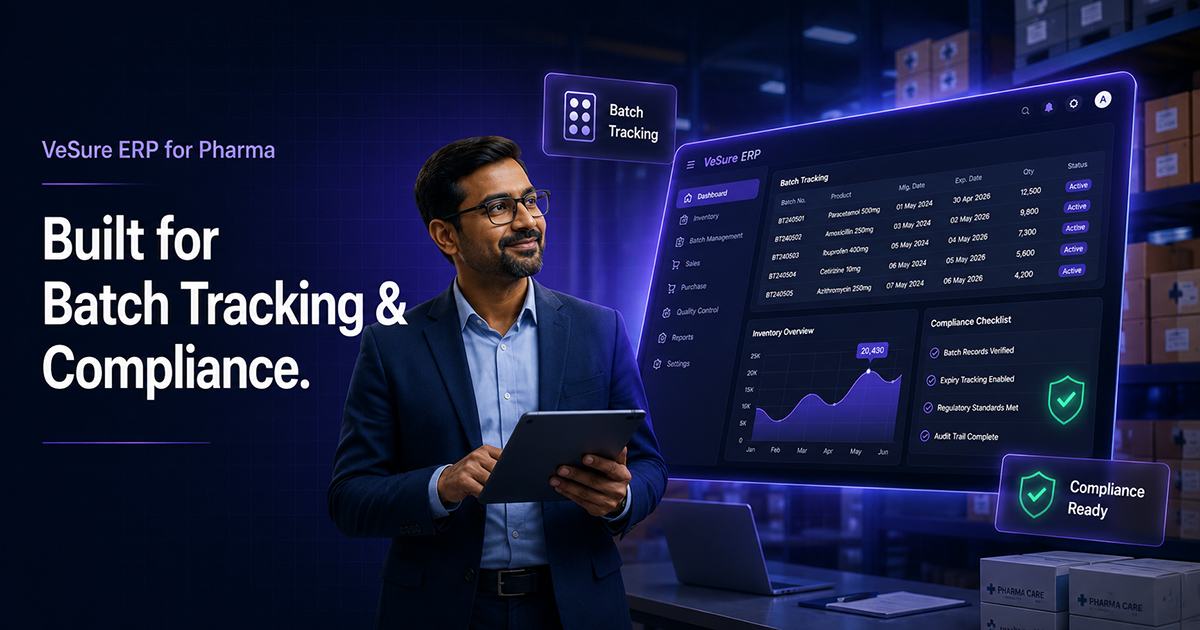
Instead of five disparate tools, VeSure ERP is designed to consolidate billing, inventory, batch tracking, and finance on one screen for the operational side of a pharma business. Distributors gain real-time stock visibility across warehouses, batch-and-expiry tracking that serves a near-expiry stock warning before any write-off occurs, and reporting pulls a traceability report in minutes rather than an entire day of manual cross-referencing.
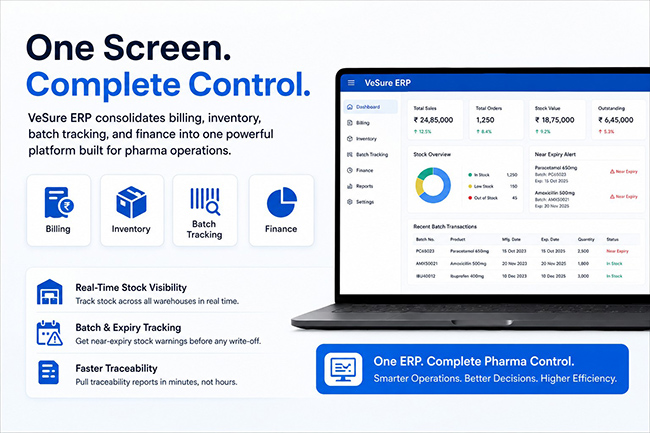
If your pharma business also operates a retail counter or chain of medical stores, the same VeSure ERP integrates with VeSure POS for daily GST-compliant billing at the store counter and with VeSure HRMS for payroll, attendance, and compliance for warehouse and field teams so that operations, HR & finance stop living in separate systems.
Mobile access means that a warehouse manager or a quality officer is not limited to accessing one desktop terminal only to check stock, approve a deviation, or pull a report; the same data can be accessed from either phone or tablet on the shop floor while being mobile.
A Distributor's Story: From Spreadsheets to One Dashboard
Take an example: a pharma distributor with 3 warehouses, in two states, buying hundreds of SKUs from multiple manufacturers. Previously, batch recalls meant pulling purchase orders from one system, sales orders from an additional system, and getting a team of people to match up the batch numbers by hand - taking as long as an entire day, but regulators want answers far sooner than that.
With one platform for billing, inventory, and batch data, the same recall trail of which retailer had what batch and how much is still in stock is a report that the compliance officer can get directly rather than waiting on three separate teams to shoot their spreadsheets over. That is the real-world difference between a connected ERP and no connected ERP - not some theoretical efficiency improvement, but on the day that really counts: responding more calmly and much faster.
How to Choose the Right ERP for Your Pharma Business
Once you've shortlisted vendors on the features above, a few practical questions decide which one is right for your business:
- Does it carry out compliance from factory audit trail, batch records, Schedule M-aligned workflows, or would you have to develop it part by part later?
- Make sure that it can integrate with your existing billing, HR, or laboratory systems so that you are not entering the same data twice!
- Does it give access for mobile or web-based staff who are not office-bound?
- Is pricing transparent, with a good understanding of implementation and training costs as well as ongoing support released?
- Does the vendor offer in-person training and responsive support, rather than simply leaving your team to self-serve off a knowledge base?
Talk to more than one vendor, ask for a working demo on your own sample data rather than a slide deck, and involve your compliance and finance teams before signing - they're the ones who will live with the system daily.
Conclusion
ERP selection for a pharmaceutical plan is not merely a productivity decision; rather, it is an instance of compliance that influences how rapidly you can respond the second something goes wrong. Focus on batch traceability, built-in regulatory workflows, real-time inventory visibility, and data security rather than having a long list of features. When your ERP is hooked up to your billing and HR tools (like VeSure ERP), that means operations, compliance, and finance finally have access to the same numbers - the very same day.
Frequently Asked Questions
What is ERP software for pharmaceutical companies?
That is enterprise resource planning software - a platform that connects all the sales, inventory, manufacturing, finance, and compliance functions of a pharma company into one. Pharma ERP is built specifically for compliance with GMP, GDP and Schedule M regulations, so it includes batch tracking, serialization and regulatory workflows not found in generic ERP.
Is ERP software mandatory for pharma companies in India?
ERP is not legally required, but the record-keeping, traceability, and audit-trail levels of standards that revised Schedule M and CDSCO inspections are now expecting from most companies can become virtually impossible to maintain with any degree of reliability on spreadsheets once a company surpasses just a few SKUs or warehouses. Most medium- to large-sized pharma companies are deploying an ERP for just that reason.
How is pharma ERP different from regular ERP software?
Generic sales, inventory, and finance are managed by standard ERP. The key difference is that Pharma RAW skills include batch-and-expiry tracking, serialization for recall management (where applicable), and quality management workflows along with compliance features mapped to pharmaceutical regulations - all of which are customizations you'd expect from a generic retail or manufacturing-focused ERP.
Can small and mid-size pharma distributors use ERP software, or is it only for large manufacturers?
Even small and mid-sized distributors are at least as well served - often better off - because there is less human capital for manual spreadsheet reconciliation when things go awry. Choose an ERP with scaled pricing so you do not have to pay for enterprise-scale features that are not truly needed yet.
Does VeSure ERP support batch tracking and expiry management?
Yes. The inventory module within VeSure ERP tracks batches and expiry dates, with stock that is approaching its expiry date flagged before a write-off occurs, as well as the ability to generate a batch-recall trail directly from sales and purchase records.
How long does it take to implement ERP software for a pharmaceutical company?
That depends on how many warehouses, SKUs, and other systems must be migrated or integrated. A distributor with a single location can typically go live in a few weeks, while a multi-warehouse or multi-brand vertical should anticipate utilizing an extended rollout that allows for the appropriate level of staff training along each tiered step.
Ready to see it in action? Book a free VeSure ERP demo and walk through batch tracking, compliance reporting, and billing on your own sample data.