Walk into any restaurant on a Saturday night and you'll see the same story play out. The kitchen is slammed, a server is scribbling an order on a notepad, and somewhere between the table and the kitchen printer, "no onions" turns into "extra onions." The customer notices. The manager doesn't, until the complaint shows up on Zomato three hours later.
This is the exact gap that restaurant POS software was built to close. Not the flashy, AI-buzzword version of it — the boring, everyday version that gets an order from a table to a kitchen screen without a human hand-carrying a piece of paper in between.
For restaurant owners — the ones running a single 20-table place and the ones juggling four outlets across the city — "benefits of POS software" isn't an abstract question. It's a very concrete one: will this save money, will it stop staff from messing up orders, and will it actually work when the internet at the outlet cuts out for the third time this month.
Here's a look at the real benefits of restaurant POS software, one by one, without the marketing gloss.
1. Improved Order Accuracy
A handwritten ticket goes through at least two human interpretations before food gets cooked — the server reads their own handwriting, then the kitchen staff reads it again. Every step is a chance for "medium spicy" to become "extra spicy."
With restaurant POS billing software, the order goes straight from the point of entry — a counter terminal, a tablet, or a mobile device at the table — to the Kitchen Display System or printer. No handwriting, no second read, no guessing. The kitchen sees exactly what was ordered, exactly how it was modified, and exactly which table it belongs to. It's a small change on paper, but one of the clearest advantages of electronic point of sale technology in a busy kitchen.
This alone is why most restaurant owners who switch from manual billing to a POS system say order-related complaints drop noticeably within the first month. It's one of the first benefits of restaurant POS software that owners actually notice on the floor.
2. Faster Billing and Higher Table Turnover
Manual billing means someone is doing mental math or reaching for a calculator while a queue builds up at the counter. Good POS software for restaurants automates the entire bill — taxes, discounts, combo pricing, split bills — the moment an order is punched in.
For a dine-in restaurant, that speed translates directly into table turnover. A table that clears faster is a table that seats another paying customer sooner. For quick-service outlets, it's the difference between a queue that moves and a queue that walks away.
3. Real-Time Inventory Management
Ask any restaurant owner what keeps them up at night and "did we run out of paneer again" is somewhere on that list. Manual stock-taking is slow, it's usually done once a day or once a week, and it tells you what happened yesterday — not what's happening right now.
A POS system tracks ingredient usage against every single order in real time. Sell a butter chicken, and the system quietly deducts the chicken, the butter, the cream that went into it — down to the recipe level, if it's set up that way. You get low-stock alerts before you're actually out, not after a customer has already ordered the one dish you can't make. This is one of the more practical advantages of pos system in restaurant settings that rarely gets mentioned first.
This is one of the most underrated advantages of using ePOS, because it's not visible to customers, but it directly protects revenue. A dish that's 86'd because nobody noticed the stock was low is a sale you didn't just lose — it's a customer who now wonders what else you're out of. Inventory control like this is consistently near the top of any list of the benefits of restaurant POS software.
4. Data-Driven Business Decisions
Most restaurant owners could tell you their best-selling dish. Fewer could tell you which dish makes them the most money after ingredient cost, or which hour of the day is quietly losing money on staff wages versus sales.
Restaurant POS software collects this data by default — every sale, every hour, every server, every item — and turns it into reports that are actually usable. Which items to push, which to drop from the menu, which time slots need more staff and which need less. This is the benefit that separates restaurants that grow deliberately from ones that grow by accident, and it's a big reason data-driven decision-making ranks high among the advantages of restaurant POS software.
5. Seamless Multi-Payment Reconciliation
Customers today pay however suits them — UPI, cards, wallets, cash, sometimes split three ways between friends who each want to pay for their own dish. A modern POS handles every payment type through one system and reconciles it automatically at the end of the shift.
Compare that to a cash drawer and a separate card machine, where closing the till means manually matching slips to entries and hoping the numbers agree. POS billing removes that friction — and closes the door on the small, repeated discrepancies that add up over a month. Clean, automatic reconciliation is one of the quieter benefits of restaurant POS software, but it's the one accountants notice first.
6. Stronger Fraud Prevention and Accountability
Cash-heavy businesses are exposed to two kinds of loss: honest mistakes and dishonest ones. Every transaction on a POS system is logged with a timestamp, an operator ID, and an itemised record. Discounts, voids, and comps all need a reason and a login — they don't just happen silently.
That visibility does two things. It catches genuine billing errors before they snowball, and it removes the easy opportunities for the kind of "adjustment" that's hard to explain later. Owners running outlets they can't physically stand inside every day rely on this the most — it's among the advantage restaurant POS software that matter more the bigger a business gets. Ask any of them what the advantages of using ePOS look like in practice, and accountability is usually the first thing they bring up.
7. Reduced Staff Training Time and Higher Productivity
A POS interface built for restaurant use — big buttons, visual menu categories, simple order flow — is something new staff can pick up in a shift or two, not a week. That matters in an industry where staff turnover is high and training time eats directly into labour cost.
Once the system is running, the automation extends past order-taking. Attendance, shift logs, and daily sales summaries are captured without extra paperwork, freeing staff to actually be on the floor instead of behind a register doing arithmetic. Easier onboarding is a practical, if unglamorous, benefit of restaurant POS software in an industry where staff turnover never really stops.
8. Seamless Integration Across Business Operations
A restaurant today isn't only a dining room. It's a Zomato listing, a Swiggy storefront, an Instagram DM taking orders, maybe a loyalty programme. A POS system that only handles the counter is only solving part of the problem.
Restaurant POS software that integrates with online ordering platforms, accounting tools, and CRM systems means an order placed on a delivery app updates the same inventory and the same sales report as an order placed at table 4. Nothing needs to be entered twice, and nothing falls through the cracks between "the app" and "the restaurant."
9. Enhanced Customer Experience
Every benefit above eventually shows up on the customer's side of the table. Orders arrive right the first time. Bills come out fast and accurate. Payment takes seconds instead of a five-minute wait for change. None of this is something a diner consciously notices when it works — they only notice when it doesn't. It's a good reminder that the advantages of ePOS aren't only operational; a chunk of them are felt directly by the person sitting at the table.
That's really the quiet advantage of ePOS: it removes the small frictions that, individually, seem minor, but collectively decide whether a customer comes back or leaves a two-star review about "slow service" that had nothing to do with the food. Customer experience rarely tops the list when people talk about the benefits of restaurant POS software, but it's the one that shows up directly in repeat business.
10. Scalability for Business Growth
A single-outlet café doesn't need the same setup as a five-location chain, but a good POS should still handle both without a rebuild in between. Owners running multiple branches can check sales across every outlet from one dashboard, keep pricing and menus consistent without visiting each location, and bring a new branch online in a day instead of setting up billing from scratch.
Plenty of restaurants get by on a notebook and a spreadsheet for the first year or two. The trouble starts when the switch to a real POS happens after the business has already outgrown that setup — it's a far messier changeover than just starting with the right system. Scalability is one of the benefits of restaurant POS software that owners tend to appreciate too late rather than too early.
Is Restaurant POS Software Right for Every Business?
Not automatically, and it's worth saying that plainly. A very small, single-owner stall doing a handful of daily orders may not need the reporting depth or multi-outlet features that a full restaurant POS system for restaurants offers. But for anywhere handling table service, a growing menu, multiple staff, or more than one payment mode — which describes most restaurants, cafés, cloud kitchens, and QSRs — the advantages of using EPOS stop being a "nice to have" fairly quickly and start being the difference between running the business and the business running you.
The right move is to actually compare a couple of restaurant POS billing software options against your outlet's specific workflow — table service versus counter service, single location versus multiple, dine-in versus delivery-heavy — rather than picking whichever one a friend uses. Weighed against a manual setup, the benefits of restaurant POS software tend to outweigh the switching effort within the first few months.
How VeSure POS Delivers These Benefits
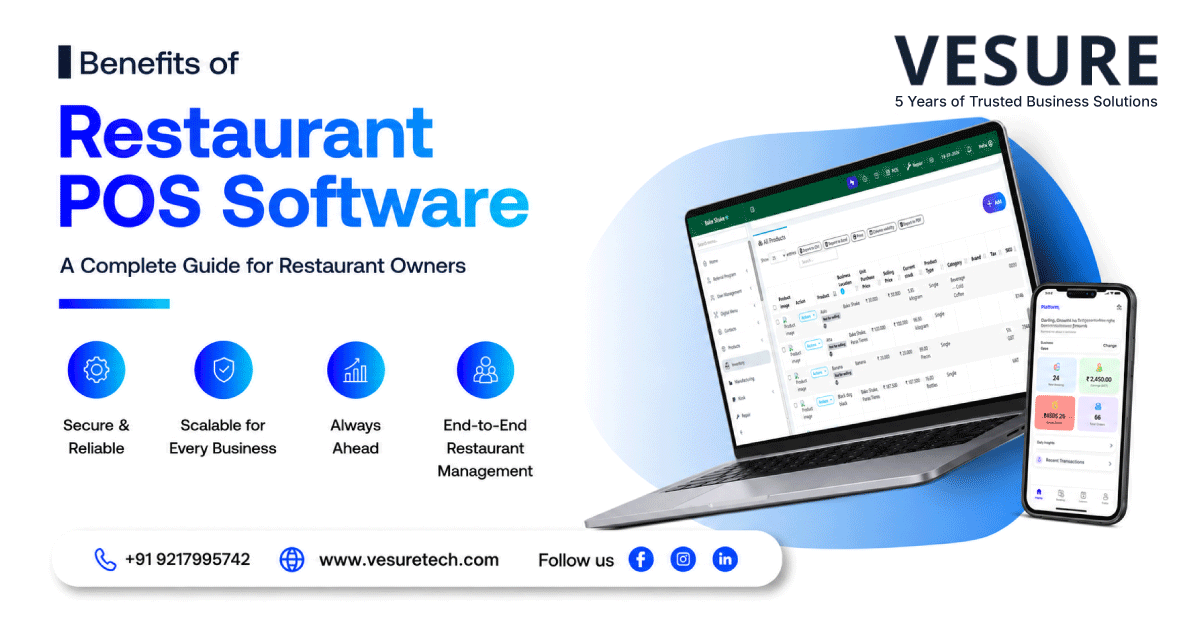
VeSure Technologies builds its SaaS based POS System Software around these exact pain points — fast billing, real-time stock tracking, and one dashboard for owners running more than one outlet. It also plugs into the payment modes and delivery platforms most restaurants are already using, so nothing needs a separate spreadsheet on the side.
A single café and a five-branch chain don't run the same way, and the system is built to handle both without forcing either into the wrong workflow. It's a straightforward way to see the benefits of restaurant POS software play out at any scale, not just on paper.
Thinking about moving off manual billing? Book a free demo and see how it holds up against your actual floor, not a sales pitch.
FAQs about Benefits of Restaurant POS Software
What are the main benefits of restaurant POS software?
The core benefits of restaurant POS software are faster and more accurate billing, real-time inventory tracking, fewer order errors between the counter and kitchen, detailed sales reporting, fraud prevention through transaction logs, and the ability to manage multiple outlets from one dashboard.
What are the advantages of using ePOS over a manual billing register?
An ePOS system automates calculations, reduces human error in order-taking, tracks stock in real time, and generates reports instantly — all things a manual cash register or handwritten ticket system cannot do on its own.
What are the benefits of ePOS for a small restaurant or café?
The benefits of ePOS for a smaller setup are the same core ones as a large chain, just felt faster: quicker billing, fewer order mistakes, and stock tracking that doesn't rely on someone counting sacks of rice at closing time.
Is restaurant POS billing software only useful for large restaurants?
No. The benefits of restaurant POS software apply to small cafés and single-counter setups just as much as large chains — faster billing and error reduction help at any size, while the reporting and multi-outlet features simply become more valuable as the business grows.
Can restaurant POS software work without a stable internet connection?
Most modern systems, including cloud-based ones, offer offline billing modes that sync data once the connection is restored, so billing doesn't stop during short outages.
Does a POS system help with food delivery orders too?
Yes. POS systems that integrate with delivery platforms pull online orders directly into the same system as dine-in orders, keeping inventory and sales reports unified across both channels — one of the more overlooked benefits of restaurant POS software for outlets that sell across multiple channels.